




Kantarawaddy Times
“We hear it every single day. It’s even louder when we’re in the fields. Just last night, it went on until dawn. If the situation gets worse, we have to go back. No one dares to stay. When something happens, and everyone else leaves, I might be left behind. Even while we are working, we have to stop and run back,” said Daw Byar, a female farmer who is living in Nanmekhon Township.
The sounds she hears are not peaceful or pleasant. They are the explosions of artillery shells, drone bombing, and gunfire, sounds that could even take lives at any moment.
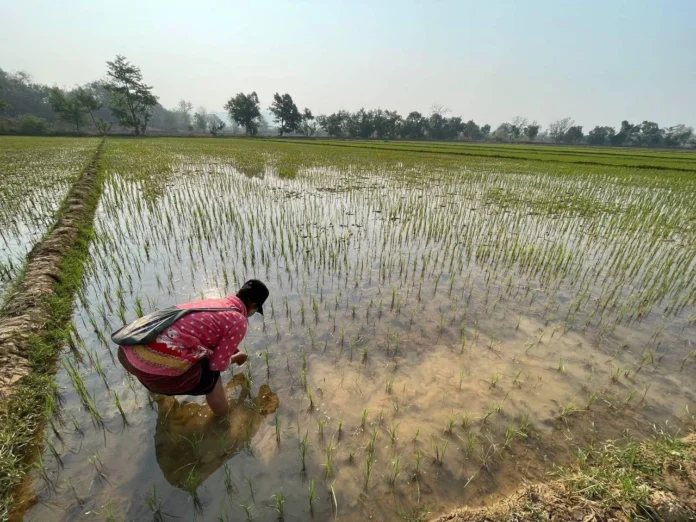
Most residents of Nanmekhon Township rely on farming as their primary livelihood.
During July, the military launched an offensive toward Daw Ngan Khar village, not far from Nanmekhon, where clashes with revolutionary joint forces have been ongoing. Residents throughout the township have been clearly witnessing and hearing daily shelling and attacks from heavy weapons and drones.
Sometimes, junta artillery shells have landed right in paddy fields, and there have also been incidents where military drones directly targeted farmers working in the fields. Despite these dangers, local people continue planting and harvesting rice while risking their lives.
Before the military coup, local farmers worked together in unity during planting and harvest seasons. That sense of solidarity has gradually disappeared since the coup.
“Back in the days when the political situation was good, if we needed to block water for the fields, we all did it together. We prepared seedlings in June and transplanted them in July. Everyone worked on the same schedule. We traveled together, helped one another, and it was enjoyable.
Now, it is like every man for himself. Some are planting while others are weeding. Everything has become scattered due to the current situation,” Daw Byar recalls those happier times with deep nostalgia.
Before the coup and the fighting began, lunchtime was one of the best moments for farmers when they would gather together in the fields, eat meals as a group, and briefly forget the exhaustion of farm work.
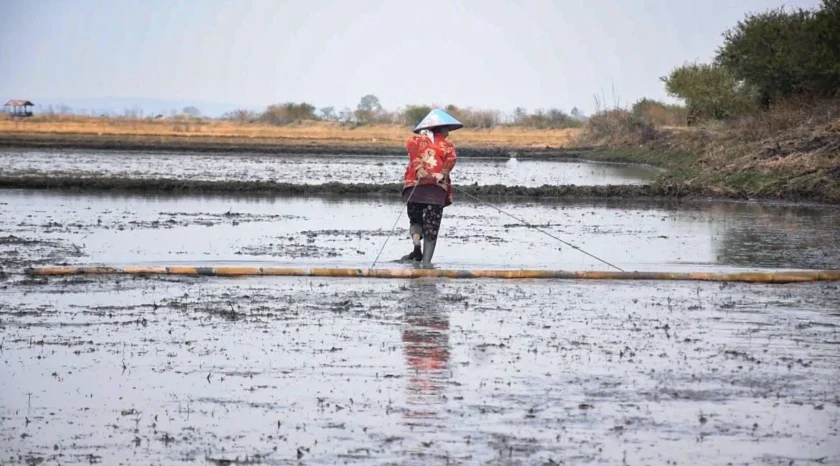
Today, due to the threat of artillery and drone attacks, people no longer dare to gather in open fields. Farmers quietly eat by themselves, focusing on finishing their work as quickly as possible. As a result, one of the most heartwarming traditions among farming communities has gradually disappeared.
According to Kantarawaddy Times’ field observations, the majority of people currently working in agriculture are women. Although men are still involved, the number of women is significantly higher.
Women farmers explained that many men have left to earn a living elsewhere, working in mining, goods transportation, or seeking employment abroad to support their families.
As a result, women have been forced to shoulder both household responsibilities and the burden of earning the family’s income.
Women like Daw Byar, who are responsible for supporting their households, must not only manage domestic duties but also endure the constant threats and attacks posed by the military while trying to secure food for their families.
Since the coup, cultivated farmland has decreased significantly. Ongoing fighting and repeated displacement have made farming increasingly difficult. Farmers are now harvesting rice planted during the previous dry season, while others are already preparing seedlings for this year’s monsoon rice crop.
For farmers living near areas controlled by the military, such as Nanmekhon, the risks are even higher.
Whether because of news of advancing military columns or the sounds of nearby fighting and shelling, many farmers are forced to harvest their rice before it is fully mature.
“Now, whenever we hear that military troops are advancing, or when artillery and gunfire get closer and closer, some are harvesting that should have been ready for next week,” said another woman farmer, Daw Florine.
Harvesting rice before it has fully matured reduces yields and results in financial losses for farmers. Even knowing this, many choose to harvest whatever they can rather than risk leaving everything behind because of the war.
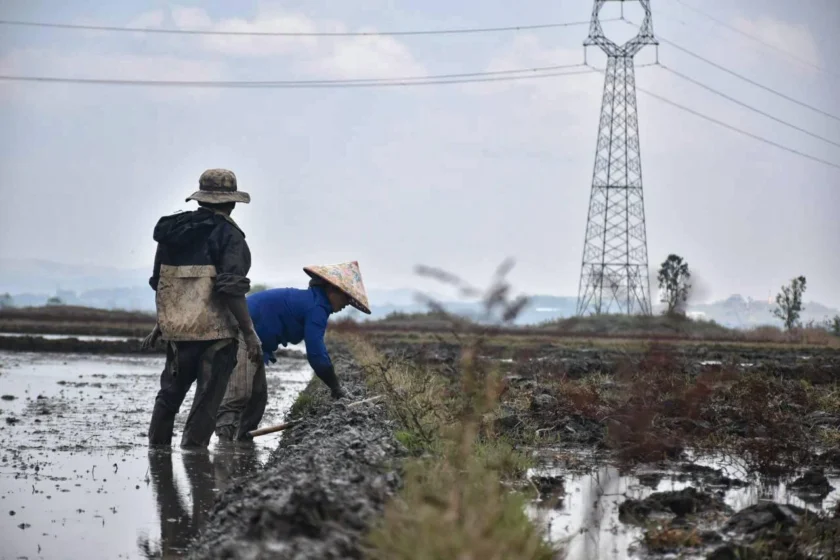
Reflecting on what could happen if farmers are unable to harvest the crops they have worked so hard to grow, Daw Florine expressed her fears for the future.
“If we cannot harvest, we will be trapped in debt. We won’t be able to repay what we owe. If we lose the crops we’ve invested so much in, we may even have to sell our farms and fields just to pay off our debts,” she describes the worst possible outcome farmers could face.
At present, the military continues its offensive toward Daw Ngan Khar while carrying out daily artillery attacks. Ground clashes are occurring almost every day.
This is the reality faced daily by farmers like Daw Byar and Daw Florine. In the coming days, they will once again have to harvest rice amid the sounds of shelling and the constant threat of attack.
For them, the harvest season is no longer a time to hope for a good yield, but it becomes a season to pray simply to stay alive.