




Kantarawaddy Times
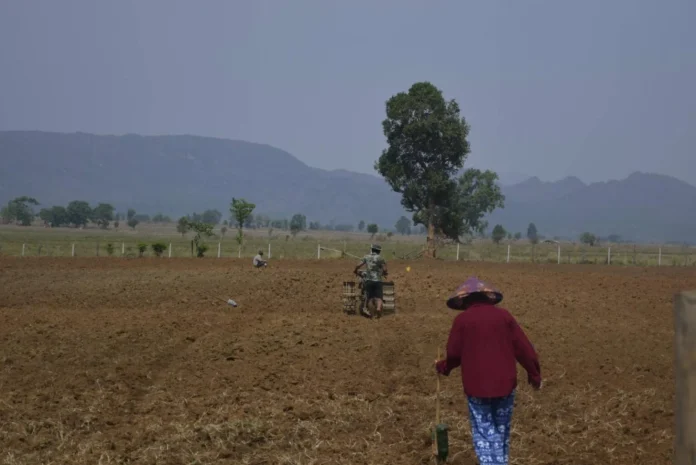
As the first rains of the monsoon season begin to fall, farmers across Karenni State are starting to prepare their farmlands for a new planting season. They are inspecting tractors that had been left unused throughout the summer and making necessary repairs.
However, even before this year’s planting season, farmers are already facing numerous challenges. In particular, transportation difficulties caused by the ongoing conflict have become a major obstacle to repairing and maintaining agricultural machinery.
“There are some machine parts that we cannot buy here. Some items were confiscated at junta checkpoints along the roads, and we never got anything back. The main issue is that the war has made transportation extremely difficult, and civilians like us are suffering the consequences,” said a mechanic from the eastern part of Demoso Township.
But this is not the only challenge they are facing. It is merely the first major hardship at the beginning of the rainy season.
In addition, fuel prices have increased due to the impacts of conflicts in the eastern-central region. For farmers without stable incomes, this has become another challenge.
Therefore, some farmers are worried that cultivation rates will decline during this year’s farming season.
“I think the cultivation rate will likely decrease this year. Gasoline and diesel prices have risen. With fuel prices this high, the price we get back from selling rice can never cover the costs. Some people will probably grow crops only for their own consumption,” said a farmer.
In previous years, tractor plowing services cost around 65,000 kyats per hour, but this year the price has reached nearly 100,000 kyats per hour.
For most farmers without stable incomes, this year’s harvest will need to serve as investment capital for the following year. Some are only able to pay tractor service fees after their crops are harvested.
In the eastern part of Demoso Township, the ability to resell rice harvested in previous years has been low.
The main reason is not only the low price of rice but also the lack of buyers. These challenges stem from the inaccessibility of transportation routes.
In eastern Demoso Township, one viss of Shwe Yin Aye and Shwe Aa rice varieties is currently worth only around 2,000 kyats at most. However, in the western part of Demoso Township, the same rice varieties can fetch prices of around 3,000 kyats per viss.
“The problem here isn’t just the prices; there are almost no buyers. The main problem is transportation. We cannot send our rice outside, and brokers cannot come in to buy from us. Some people still haven’t been able to sell their rice, so they haven’t even paid off last year’s machinery costs yet. But in the western areas, where transportation is much easier, rice prices are far better than here, and there are buyers as well,” said a local farmer from eastern Demoso Township.
Currently, one bag of fertilizer costs around 150,000 kyats, while gasoline and diesel prices have exceeded 10,000 kyats per liter. Under such conditions, farmers are entering the coming planting season while facing enormous challenges.
At a time when ongoing conflict has made it increasingly difficult for people to travel freely and earn a living, ancestral farmlands have become a vital lifeline for displaced civilians.
Nevertheless, in Karenni State, where clashes occur frequently, most farmers who continue to work also worry about the constant fear of drone strikes and artillery attacks carried out by the military junta.