




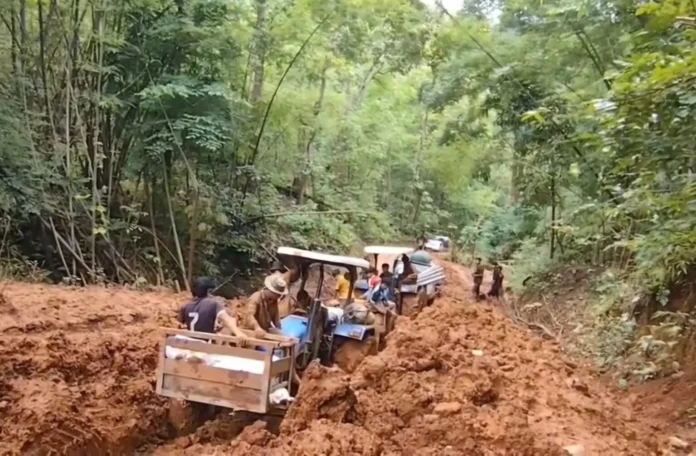
Kantarawaddy Times
A scene from a journey I (a journalist of Kantarawaddy Times) took about five months ago remains in my mind. At the time, I was traveling from Demoso Township toward Mase Township for work. I encountered the scene on the Mawchi–Mase road, after we had traveled more than halfway through our journey.
In front of our vehicle was a Revo pickup truck. A man wearing a black shirt was riding on top of the truck, holding a large bottle of medicine in his hand. The bottle was connected by tubing to the hand of a pregnant woman riding in the back of the truck.
The woman was wearing a worn-out longyi and appeared to be in the late stages of pregnancy. She seemed close to giving birth. She leaned against the side of the truck, and her face looked exhausted. She pressed one hand against her aching abdomen, gritting her teeth through the pain. In the vehicle, an older woman who seemed to be a relative and a child around seven years old were traveling with her.
It is inevitable that they were traveling toward Mase Township or another place where she could receive medical care. The scene reflected how, since the military coup, people in Karenni have lost almost everything, from food and water to access to medicine and healthcare.
At the time, I was traveling from Demoso in central Karenni toward Mase in the southeast. According to the map, the journey was nearly 99 miles long. If we were able to travel along the Union Highway, it would just take around five hours.
However, after around 200 junta troops launched an offensive into Hpasawng in September 2025 and took control of the Loikaw–Demoso–Hpasawng Union Highway, my journey ended up taking three days. Because we had to avoid military-controlled areas, the journey was estimated to be more than 100 miles by road.
During the current conflict, time is very valuable for travelers. Even a slight delay can lead to travel disruptions and security risks that are frighteningly unpredictable.
If a journey is difficult even for ordinary people like us to navigate such uncertain roads, how much more dangerous must it be for an exhausted pregnant woman carrying a small life inside her?
We drove through the mountains and forests until 10 p.m, and spent the night in a roadside hut. There was no roof or shelter, and the weather was cold. I am usually prone to fevers when exposed to cold weather, but luckily that day I did not fall ill.
While my colleagues and I were sleeping beneath a large tree, we woke up at around 5 a.m. due to drops of dew falling from the leaves. When I looked around, the area was covered in mist. Our driver was waiting for us to wake up while sitting beside a small fire and smoking a cigarette.
On March 2, we resumed our journey at 6 a.m. To reach Mase, we must cross the Salween River at Hpasawng. Unfortunately, just days before our trip, on the morning of February 17, revolutionary forces had blown up the Salween Bridge. They said the bridge had been destroyed for military strategic reasons. As a result, we had to cross the river by motorboat.
Throughout the journey, military tensions between the two sides were very tense. Before even reaching the riverbank, we heard the thunderous sound of artillery fire. Because of the security situation and to avoid further delays, we had to reach the Salween River by 10 a.m. to cross.
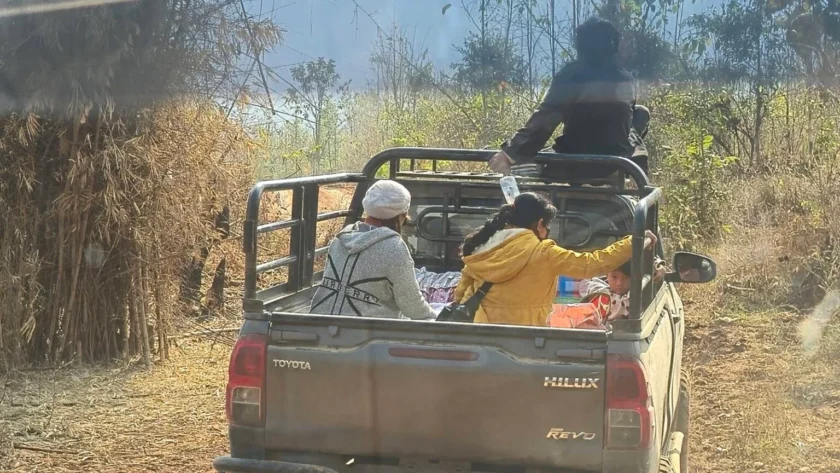
At that time, we had to pay 400,000 kyats per vehicle just to cross the river. This fee covered only the river crossing and did not include any other travel expenses. We waited in line for about half an hour. When it was finally our turn, the vehicle carrying the pregnant woman was allowed to cross ahead of us because it was considered an emergency.
I did not have a chance to speak with them. There were many vehicles waiting behind us, so everyone was in a rush. I assumed that many of those crossing the river for medical treatment or childbirth were likely from the Mawchi area. Although Mawchi is well known for its mining industry, there have been almost no proper healthcare services there since the coup.
Local residents had told me that while some medicines were available for people with common illnesses, there were no healthcare workers or necessary equipment to treat more serious emergencies.
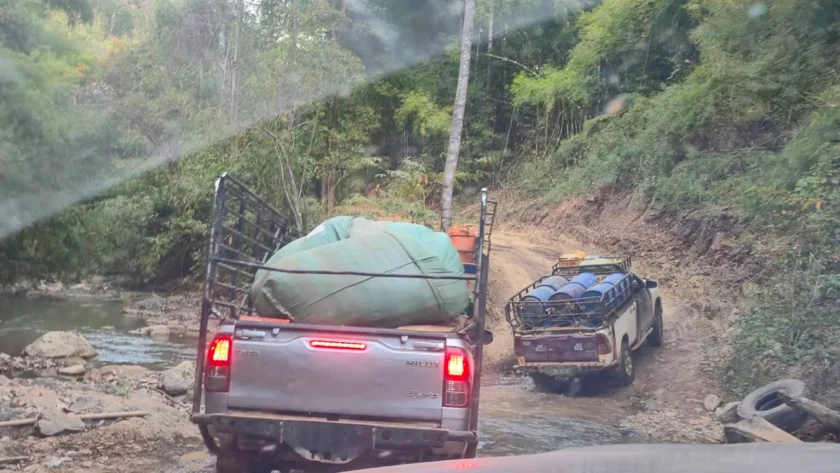
The vehicle carrying the pregnant woman traveled ahead of ours, jolting and shaking as it crossed the hills. Even as an ordinary passenger, I felt sharp pain in my abdomen from the constant shaking of the vehicle. I could not help but imagine how painful the journey must have been for her while carrying a baby in her womb.
For me, who has traveled this route many times, this was the second time I had seen a vehicle carrying a woman in labor. The first time, I saw a mother returning home from the other side of the river carrying her newborn baby wrapped in a white cloth. I wondered how many such cases are happening across Karenni State.
Due to the military situation and transportation difficulties in the state, mothers face many challenges in giving birth and accessing healthcare services related to maternal health.
There were even more serious cases in Karenni. On July 27, a 35-year-old mother died after suffering severe bleeding following childbirth because she was unable to receive medical treatment in time. She had given birth with the help of a traditional birth attendant in a village in Hpruso Township. Because the placenta did not come out, she suffered postpartum hemorrhage.
Villagers tied a longyi tightly to a bamboo pole and had her lie on it. They covered her with a tarpaulin to protect her from the rain and carried her on foot for two hours to a clinic for treatment. However, she died while receiving medical care.
There was another case. On April 24, a pregnant woman carrying twins from the western part of Hpruso Township, known as the Kayaw area, went to a hospital to give birth but ended up delivering her babies along the way.
Because of the distances between locations and the lack of internet access, it was very difficult for us to even contact her.
What is the root cause of accessing medical treatment? When I spoke with a female healthcare worker in Pekhon Township, she explained that transportation was the main problem.
“It’s not that people cannot travel. But we ask them to find a vehicle, and sometimes they encounter situations where no one will provide one. Then we have to look for a vehicle ourselves. Sometimes the patient is almost going into shock, and we have to run around and search for a vehicle ourselves. It’s not that we cannot travel at all, and it’s not that patients die simply because they cannot travel. The main problems are that it is difficult to hire a vehicle and that transportation costs are expensive.”
Small clinics can provide antenatal appointments and basic health checkups for pregnant women. However, they cannot handle miscarriages, severe bleeding, or cases requiring surgery. As a result, when serious complications arise, mothers often have to travel long distances.
According to the annual report of the Interim Executive Council (IEC), during 2025 there was one maternal death, 24 newborn deaths, and 173 cases of miscarriage in Karenni.
Although transportation is one of the major challenges, there are other issues that governments also need to address. They are the shortage of skilled healthcare workers and inadequate medical equipment.
The Karenni Women’s Organization (KNWO), an organization active on women’s issues, says pregnant women and children in Karenni are not receiving adequate healthcare. Although healthcare providers are doing their best to deliver services, they continue to face difficulties because of transportation problems, the military situation, shortages of medicines, and the remoteness of many areas.
“Organizations need to expand mobile health activities, especially by reaching remote areas where access to healthcare is difficult because of transportation problems. That way, the impact on their health care and the losses they suffer can be reduced,” said Maw Phray Myar, chairperson of KNWO.
In Loikaw, an area under military control, a 500-bed public hospital has been reopened since January this year, providing medical treatment. The hospital had been closed following ‘1111 Operation’ in 2023.
In Karenni State, there are two administrations within the state. For most people living in revolutionary-controlled areas, seeking medical treatment at facilities opened by the military-controlled administration is a major challenge. As a result, they generally do not consider traveling to those facilities for treatment.
Meanwhile, hospitals and clinics under the Karenni Interim Executive Council (IEC), the revolutionary administration, as well as facilities operating in cooperation with the IEC, are providing healthcare services in different areas. However, they are still unable to cover the entire state.
According to a six-month report from the IEC Health Department, during the first six months of 2026, healthcare services were provided to 49 women who underwent cesarean deliveries and 425 women who gave birth naturally. This means a total of 474 births were assisted during the six-month period.
Although pregnant women can access basic healthcare services through departments under the IEC Health Department in their respective areas, emergency cases often have to be referred to healthcare facilities outside their local area or township for further treatment.
Dr. Lily, a doctor working in Karenni and collaborating with the IEC, said that the clinic where she works is still unable to provide cesarean deliveries and other emergency maternal healthcare services.
“It’s about both facilities and equipment, as well as human resources. At present, we don’t have an obstetrician-gynecologist (OG) specialist. The OG specialist provides consultation remotely online and takes responsibility for cases that require their expertise. Normally, I work as a general practitioner. If something can be handled at the general-practitioner level, I handle it. But if there is something I cannot make a decision on myself, I consult the relevant specialists. If the specialists were physically available at the facility, we would be able to provide more services,” she said.
The pregnant woman I saw beside the Salween River on March 2 was most likely from the Mawchi area. According to the map, the mother was traveling approximately 53 miles through Karenni’s conflict-affected areas, partly by land and partly by water, to give birth.
But with the revolution still unfinished and armed conflicts intensifying, mothers in Karenni will continue to make long and difficult journeys to safely bring the babies they have carried for nine months into the world.