




Saw Eh Kanyaw (Kantarawaddy Times)
At a small school in the “Letpan Kwin” IDP camp, located on the western side of Moebye town along the Shan–Karenni border, as the evening school bell rings, children, each carrying their small school bags, race one another back to see who will reach their makeshift huts first.
Although they are students, they do not have matching school uniforms. They do not have beautiful backpacks. They lack sufficient learning materials, such as no proper textbooks, notebooks, or teaching aids. Yet there is one thing they all share: a strong desire to go to school, to learn, and to study well.
These children, aged between 12 and 15, after arriving home and tossing aside their bags, instead of playing as children normally would, help their parents by fetching water and gathering firewood. For the older students, they assist by cooking meals for their families.
Even though the school year is nearing its end and exams are approaching, they continue to do everything they can to support their families.
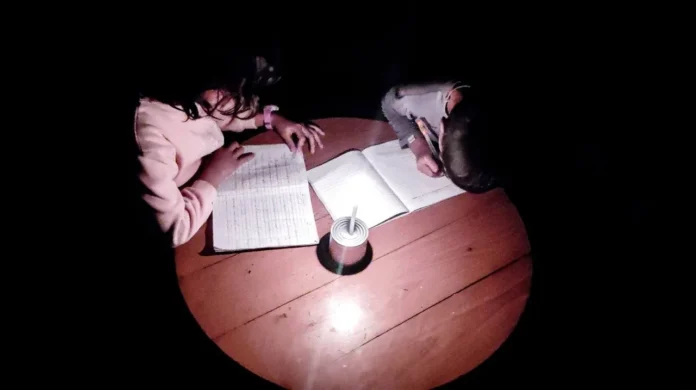
Their study time comes only at night. But even then, there is barely enough light for children of school age to read and study.
Without electricity, they rely on dim solar lamps, candles, flashlights, or sometimes small oil lamps. Under these faint lights, children hold their books tightly, studying with determination, each holding onto their own dreams for the future.
“Children study by candlelight. Some use small flashlights,” said one parent, describing how children in the camp manage their studies.
Due to the ongoing conflict, Karenni people have been forced to flee their homes and move repeatedly in search of safety. As a result, children’s education has become unstable. In addition, threats from the military regime often disrupt the school year.
“When planes come, sometimes they drop bombs, so schools have to close. That’s why we can’t study properly,” said Ma Jenny, an eighth-grade student, sharing her experience.
Ma Jenny dreams of becoming a nurse. She also has a passion for dancing and hopes to become a dancer.
A teacher named Juster, who teaches at the IDP school, spoke about the challenges, noting that most schools in Karenni State are community-based and, with most students being displaced, the school faces many needs.
“We only receive a small amount of stationery support from IEC, and it’s not enough. We need more supplies, such as ink, marker pens, and whiteboards. There are no blank notebooks and textbooks as well,” she said, expressing her frustration.
As displaced families, they cannot afford private tutoring. Many parents themselves did not have the chance to complete their education, so they are unable to help teach their children. Instead, the children help one another, with older siblings teaching younger ones, studying together at night.
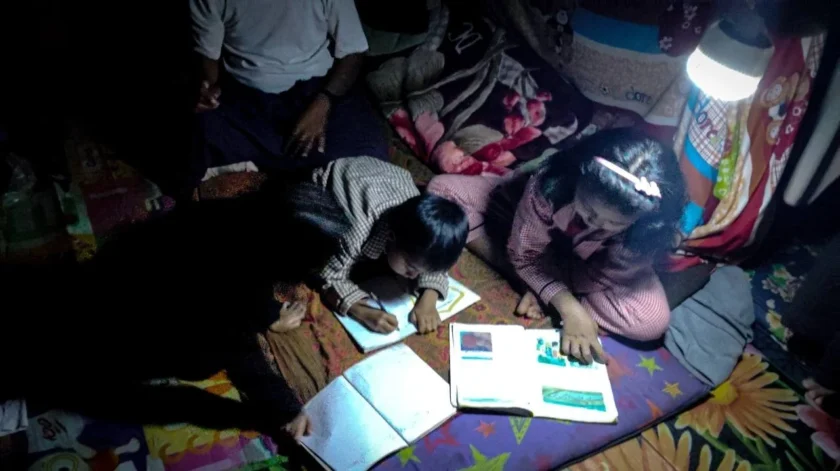
“Back in my day, when we were living in Kayah (Karenni) State, even though there was a hydropower plant, electricity was as dim as a tomato. We studied by candlelight, and when we couldn’t afford candles, we read books by the fire using pine oil. Now it feels like children are going through the same situation we did,” said Daw Theresa.
As she recalled the past, her voice faded with emotion. She feels deep sadness seeing the suffering of war, whether it is the legacy of conflict or dictatorship, being passed down from her generation to her children’s generation.
As the season transitions from winter to summer, studying by candlelight becomes even more dangerous. The tents in the camp are tightly packed, so a fire could endanger not only one family but the entire community.
Because of this fear, some parents stay awake to watch over their children as they study, unable to teach but ensuring their safety.
These young generations, who will one day shine brightly, are now shaping their futures amid insufficient light.
“When children study, they have to concentrate so hard, so we worry about their eyesight. In this situation, they could develop poor vision and even need glasses. As displaced people, we don’t have jobs, so we can’t afford to buy solar lamps,” said another parent, describing their difficulties.
While studying at night, there are also moments when they must quickly blow out candles or switch off lights when aircraft approach, which is something IDP families have experienced countless times.
Ironically, the hydropower plant that supplies electricity across Myanmar is located in Lawpita, Karenni State. Yet children in Karenni, including those along the Shan–Karenni border, still study by candlelight.
Studying in the dark is not a choice for these children. But who can stop the steps of hope as they move from darkness toward the light? Every word written on paper under the faint glow of a candle or oil lamp is shaping each child’s future.
To brighten that future, those small lights emerging from the darkness must grow into a greater light, and that will require the collective support and participation of everyone.