




Download PDF File – Monthly Summary of Key Events in Karenni(August 2026)
KNPP General Secretary U Aung San Myint Passes Away
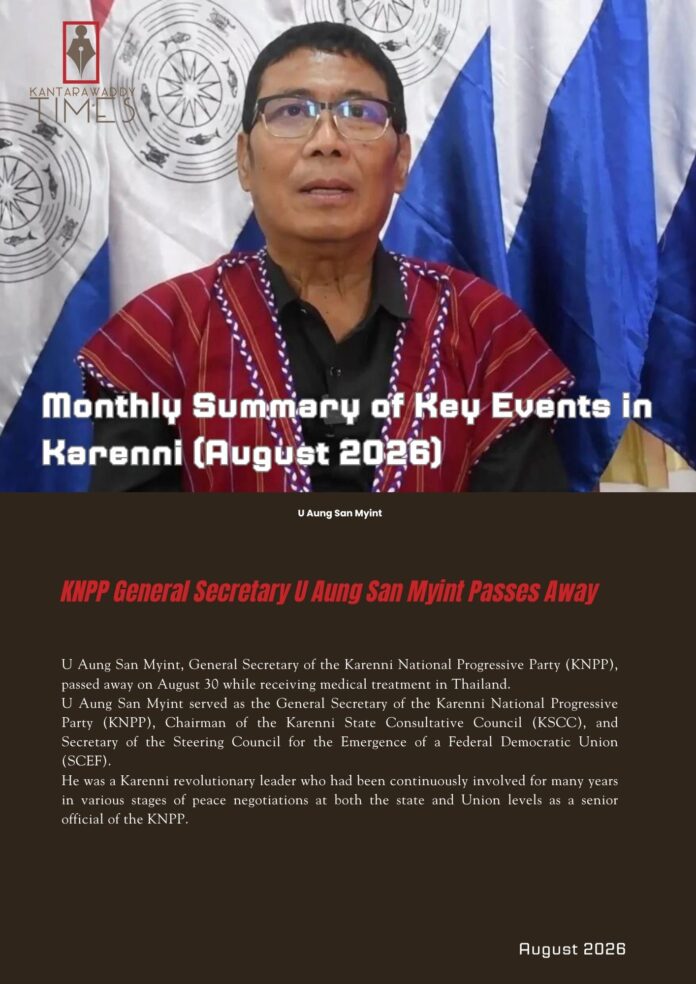
U Aung San Myint, General Secretary of the Karenni National Progressive Party (KNPP), passed away on August 30 while receiving medical treatment in Thailand.
U Aung San Myint served as the General Secretary of the Karenni National Progressive Party (KNPP), Chairman of the Karenni State Consultative Council (KSCC), and Secretary of the Steering Council for the Emergence of a Federal Democratic Union (SCEF).
He was a Karenni revolutionary leader who had been continuously involved for many years in various stages of peace negotiations at both the state and Union levels as a senior official of the KNPP.
Military Situation
Since May, the junta troops have been conducting military operations toward Dawngankhar village in Demoso Township. As they moved closer to the civilian areas, local residents were once again forced to flee during early August.
On August 26, junta troops entered a village in the western part of Hpruso Township (Kaylyar Township), forcing local residents to flee. According to local residents, a local man was injured after junta troops suddenly arrived and fired guns at close range.
Around 400 people from four villages, including the village where the junta troops entered, have been displaced. Throughout August, the junta has been conducting military operations in Hpruso Township, with frequent drone bombing targeting civilian areas. The displaced population is currently in urgent need of assistance.
Recently, nearly 200 junta troops have been advancing in areas near the Shan-Karenni border close to Nanmekhon Township, and small clashes with revolutionary forces have been occurring.
As a result, Moebye PDF issued a warning on August 27 urging people not to travel on any of the roads connecting the Shan-Karenni border areas of Lwelwine, the foothills of Lwelyin, Liwo, and Nanmekhon.
Junta Attacks on Civilians Throughout August
According to news reports published by Kantarawaddy Times during August, a recurring pattern of attacks, especially drone strikes, can be observed in Karenni State, particularly in Hpruso Township.
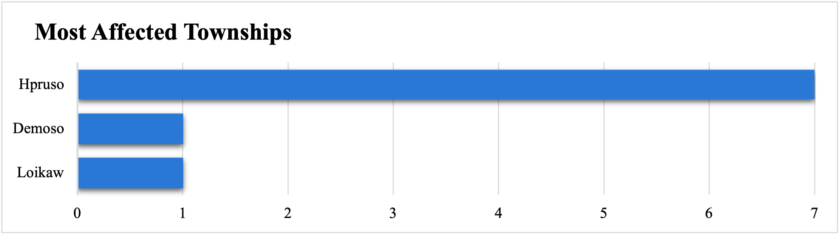
The junta is not using drones, artillery, and airstrikes only in ground combat. It has increasingly targeted civilian areas, including upland farms, villages, displacement camps, and schools.
What the Figures Show
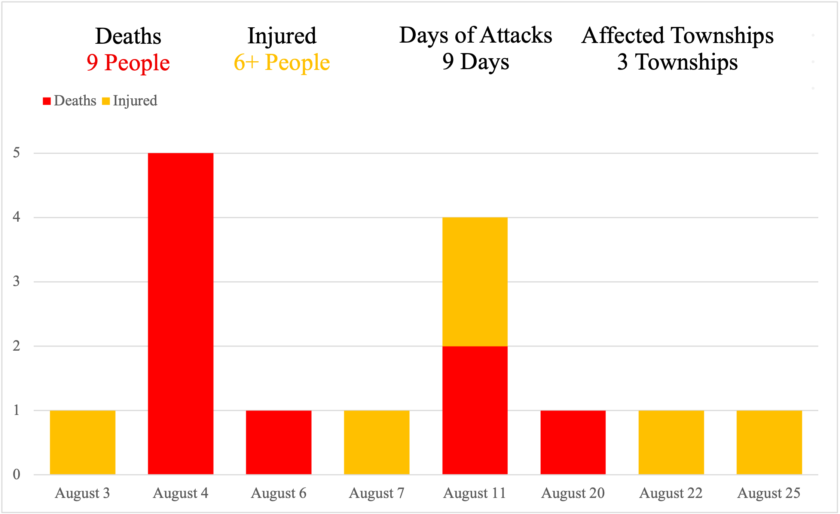
August 3: A woman over 40 years old was injured by a drone bomb while planting peanuts in eastern Hpruso Township (Kaylyar Township).
August 4: Two drone bombs were dropped on a village in western Hpruso Township, killing five civilians, including a five-month-old baby.
August 6: A jet fighter attacked a displacement camp in western Demoso Township, killing a 50-year-old man and destroying a middle school building.
August 7: A farm worker in eastern Hpruso Township (Kaylyar Township) was injured by a drone bomb.
August 11: A displacement camp in eastern Loikaw Township was attacked by three suicide drones, killing two civilians and injuring two others.
August 18: At least six drone bomb attacks occurred in a single day in Hpruso Township, damaging locals’ homes.
August 20: An IEC emergency rescue worker was arrested and tortured to death in Hpruso Township.
August 22: A 17-year-old schoolgirl was injured by a drone bomb while planting peanuts in Hpruso Township.
August 25: A 35-year-old female farmer was injured by a drone bomb in Hpruso Township.
August 26: Junta troops advanced into western Hpruso Township. A civilian was shot at close range with a small firearm, while around 400 people from four villages were forced to flee.
These figures do not represent a complete record of all incidents that actually occurred in Karenni. They are compiled only from information that Kantarawaddy Times was able to access and verify.
Based on these records, at least nine civilians were killed, and nearly 10 others were injured in Karenni State during August alone.
Analysis of the Attacks
According to the available information, it can be seen that the civilian casualties may have occurred because fighting was taking place in and around the areas. However, an overall review of local news reports and records published throughout August reveals the following patterns.
- Repeated Targeting of Farmers
According to local residents interviewed in news reports, farmers working in upland fields were repeatedly targeted by drone bombings on August 3, 7, 15, and 22. These repeated attacks could indicate that the junta is deliberately targeting farmers to prevent local communities from meeting their food needs during the current cultivation season.
- Targeting Displacement Camps and Schools
News reports indicate that junta attacks have destroyed school buildings and shelters at displacement camps, while also causing the death of an infant. These incidents did not occur on or near active battlefields. Instead, they took place in areas that the junta ground columns could not easily reach.
- Even Humanitarian Aid Workers Are Not Spared
The arrest, torture, and killing of a rescue worker by junta forces constitutes a violation of international humanitarian law. Such acts of brutality must be clearly documented.
- Attacks Inside Civilian Villages
In late August, in addition to drone and artillery attacks against civilians, junta troops began directly advancing into villages and carrying out close-range shootings of civilians. For local residents, there was no choice but to flee suddenly for their safety.
Consequences
Looking at the impact of these attacks, children, women, and elderly people have suffered the most deaths and injuries. In addition, schools have been damaged or temporarily closed, while hundreds of people have been forced to flee. Due to the ongoing attacks during the rainy season, displaced people are facing increasing shortages of shelter, food, and healthcare.
In short, these incidents cannot simply be dismissed as “collateral consequences of war.” They are documented cases of crimes committed against civilians by the junta. These records will remain as evidence of the junta’s human rights violations in the future.
At the same time, ASEAN and the international community need to increase pressure on the junta to stop its continued air and drone attacks targeting civilian areas, schools, displacement camps, and villages. The attacks aimed at cutting off the population’s long-term food supply must also be stopped.
An Egg Costs 2,000 Kyats in Western Hpruso
In an area in western Hpruso Township, a single egg now costs 2,000 kyats. Goods from that area must be transported from western Demoso, and supply route difficulties have driven prices up sharply. A female shopkeeper said that in some shops, a single egg costs as much as 2,500 kyats.
Prices of all goods in the area are about three times higher than in western Demoso Township, where the goods are purchased. In Demoso, an egg costs around 800 kyats. However, due to transportation costs from Demoso, commodities are priced at 15,000 kyats per viss of onions, 20,000 kyats per viss of garlic, 30,000 kyats per viss of cooking oil, 95,000 kyats per sack of salt, 20,000 kyats per viss of potatoes, 280,000 kyats per sack of rice, and 18,000 kyats per liter of gasoline. Fresh vegetables have not yet been able to reach the area.
Around 300 people, including local villagers and displaced people, live in the area. For vegetables, they mainly grow and eat seasonal pumpkin leaves. Due to transportation difficulties and high transport costs during the current rainy season, communities in various parts of Karenni State are experiencing increases in fuel and commodity prices.
Junta Bans Gasoline Sales in Lawpita
The junta has banned the sale of gasoline in Lawpita, a town in Loikaw Township that is under junta control. Local residents said the ban on gasoline sales has been in place for about a week. Shop owners are afraid to sell gasoline because they have heard that they could be fined and punished if they are caught doing so.
Local residents have to pay around 8,000 kyats per liter for gasoline. The junta has set up checkpoints along the main road leading to Lawpita and is inspecting cargo trucks. The transportation of gasoline into the town has already been prohibited by the junta. Lawpita is an area under junta control, and clashes between junta forces and revolutionary forces occasionally occur in surrounding areas.
Around 7,000 Karenni Youth Working Abroad Since the Coup
Around 7,000 young people from Karenni State have gone abroad to work for various reasons since the military coup in 2021, according to the Department of Youth Affairs under the Interim Executive Council (IEC) of Karenni State.
The IEC’s Department of Youth Affairs said that although the current departure of large numbers of young people to work abroad may not yet have a significant impact on the state, there are concerns that the human resources available to contribute to the community will decline over the next few years. Most of the approximately 7,000 young people working abroad are between the ages of 18 and 35, with males making up the larger proportion.