




Kantarawaddy Times
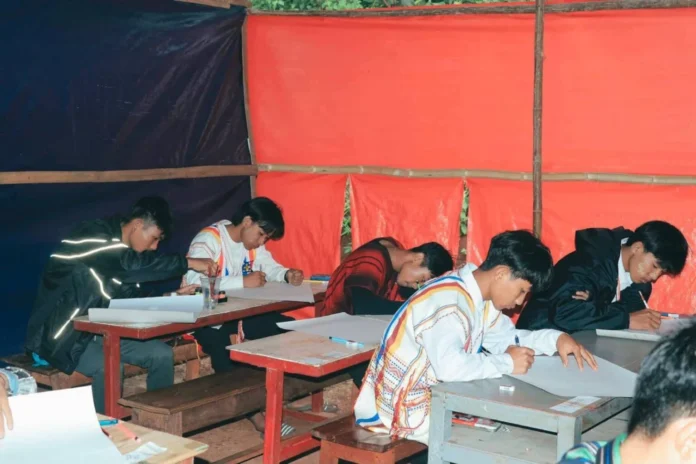
Imagine an image of a teenage girl named Pasqualina, who is studying under the dim light of a solar lamp inside a temporary shelter at a displacement camp.
That was her daily life nine months ago. But now, those days have become a part of the past that she can never return to.
If she continued her studies in the classroom, she would now be in Grade 12 together with her beloved friends. But now, she is working as a domestic worker in Singapore for eight months to support her family.
This is not a story experienced by Pasqualina alone.
According to records from the Department of Education under the Interim Executive Council (IEC) of Karenni State, there are over 6,600 students who have stopped their classroom education.
Although it is hard to know the exact reasons behind students dropping out of school, a teacher once told Kantarawaddy Times that most are due to family hardships.
According to a report by the United Nations Development Programme (UNDP) released on October 3, 2025, 41.8 percent of students in Karenni entered the workforce, and most have given up on school education due to declining interest in education, household responsibilities, the need to support family members, and weak security and transportation difficulties.
On the other hand, the Department of Youth Affairs has reported that approximately 7,000 Karenni young people have left the country and are working abroad following the military coup.
Most of those who have left are young people between the ages of 18 and 35.
In the short term, leaving school to work may be a way for young people to help their families survive financially. However, in the long term, this situation could lead to a shortage of skilled professionals and human resources for Karenni State.
The education crisis in Karenni does not end with students dropping out of school. Teachers are also leaving the education sector.
At a middle school in Demoso Township, Karenni State, which has approximately 500 students, six teachers left their teaching positions within two years due to financial hardship, according to a female teacher at the school.
“Teachers come in, and if the situation is not okay, they leave again. In the end, children just become test subjects,” the teacher said.
She further explained that teachers often leave when they have more experience in teaching, which forces schools to recruit new teachers repeatedly. As a result, the effectiveness of students’ learning has declined.
To address the teacher shortage, the Department of Education under the IEC is providing one-month teacher training courses for students who passed Grade 10 under the previous education system, as well as those who finished Grade 12 in the revolutionary-controlled areas after the coup.
However, even among those who complete the training and begin teaching, some eventually leave their jobs because of financial difficulties, the teacher said.
“There are also difficulties and challenges for school committees in villages in recruiting new teachers. Providing training for newly recruited teachers requires more time and financial resources, and there are also difficulties in maintaining the quality of education,” said the Executive Director of the Seh Theh Foundation.
The Seh Theh Foundation is an organization working in the education sector in Karenni State.
According to the Seh Theh Foundation’s records, there are more than 50,000 students and 4,760 teachers in Karenni State this year.
Currently, the shortage of teachers varies depending on the location, and high school-level teachers are in greater need, the Seh Theh Foundation’s Executive Director said.
“Especially, we need more teachers who are qualified to teach at the high school level. Teachers who can teach subjects such as chemistry, physics, science, mathematics, and English are in greater need,” the Executive Director said.
Teachers’ Salaries and School Fees for Students
The Interim Executive Council (IEC) of Karenni State provides teachers with an allowance of 800 baht (approximately 120,000 kyats) every three months.
In addition, the Karenni State Education Board works with NGOs to provide teachers with a monthly allowance of around 100,000 kyats. However, teachers receiving financial support from the Education Board no longer receive support from the Department of Education.
With education personnel receiving an average of only around 100,000 kyats per month, teachers have had to collect school fees from parents at a rate of 7,000 kyats per child to make ends meet, the female teacher said.
The fee rates can vary based on regions, and some schools have to increase their fees depending on the situation.
According to a Kantarawaddy Times report published on September 9, some parents facing financial difficulties said that they have started to consider taking their children out of school in response to rising school fees.
In Demoso Township, where a large number of IDPs are living, employment opportunities are limited, and commodity prices are high. As a result, families begin to prioritize survival over the children’s education.
Currently in Karenni State, depending on the location and type of rice, a sack of rice costs between 100,000 and 150,000 kyats, while a single egg costs around 800 kyats.
According to the World Bank, Myanmar’s inflation rate rose to 24.6 percent in April 2026 compared to five years ago. This condition has significantly impacted low-income households.
As a result, the lack of resources needed to retain teachers within the education system is ultimately having a direct impact on students.
Family Livelihood and a Student’s Choice
There are five siblings in Pasqualina’s family. Except for the eldest brother, who had already finished school before the military coup, the remaining four siblings are attending schools under the IEC education system.
As an IDP family, her parents have no jobs to earn income, and her father also suffered from health problems.
One of her older sisters left school and joined a revolutionary force, while her eldest brother is also in a revolutionary force.
Pasqualina had to pay 10,000 kyats in monthly school fees and was often hesitant to ask her parents for the money.
Every Saturday, during school holidays, she collected and sold cow dung or took up daily-wage jobs whenever she could not collect enough. She used the money to pay her school fees.
Eventually, she dropped out of school just two months before the end of the academic year.
“I wanted to support my parents with more money after dropping out,” Pasqualina said.
She is now working as a domestic worker in Singapore. She said she would not consider returning to school until the political situation improves.
Her other three siblings have also dropped out of school and entered the workforce because of the family’s financial difficulties. Only her youngest sister continues her education, with financial support from Pasqualina and the family.
Are There Pathways Back into the Classroom?
According to the Department of Education of IEC, completing the entire education journey, from basic education to higher education, can normally take up to 27 years. This includes pursuing specialized subjects and obtaining a degree. For medical degrees, the process can take even longer.
However, in conflict-affected areas such as Karenni, where people have been displaced by fighting, it is hard to complete education by following the normal education pathway. Therefore, the Department of Education says it is necessary to develop more flexible learning pathways, including credit transfers, recognition of prior learning, accelerated learning programmes, and opportunities for lifelong learning.
The IEC Department of Education also said it plans to introduce an accelerated education programme to help students who have left school for various reasons before completing their basic education back into the education pathway.
At the same time, while continuing the interim education system, the department is working to establish a federal education system as part of its long-term institutional development.
“Rather than asking every student who has dropped out to return to the school, we are developing different educational pathways based on their current situation, age, and learning levels,” said Maw Mi Mar, Head of the IEC Department of Education.
Currently, in Karenni revolutionary-controlled areas, there are eight higher education institutions with 1,095 students and 446 basic education schools with 50,926 students working in coordination with the IEC Department of Education.
Where Does the Education Chain Break?
In Karenni, students are dropping out of school, while teachers are leaving their jobs because of financial hardship.
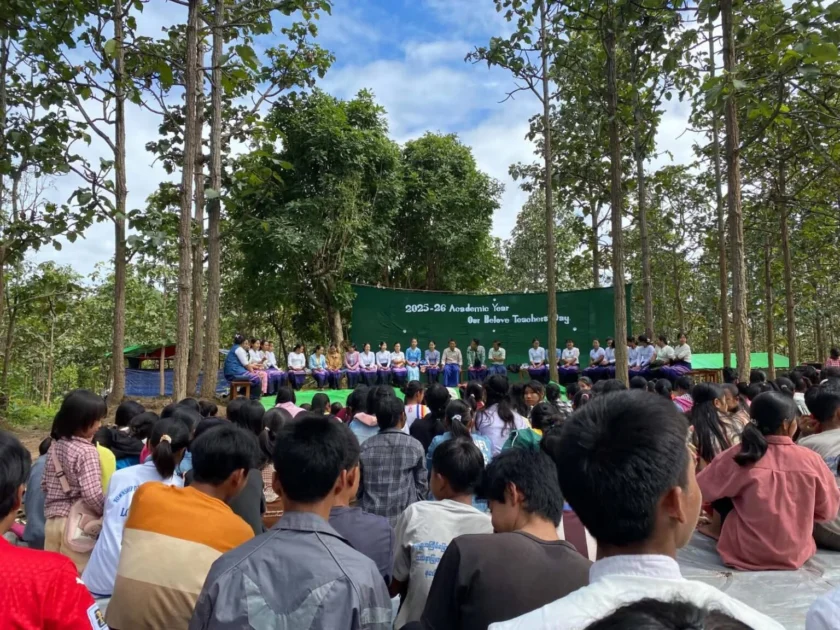
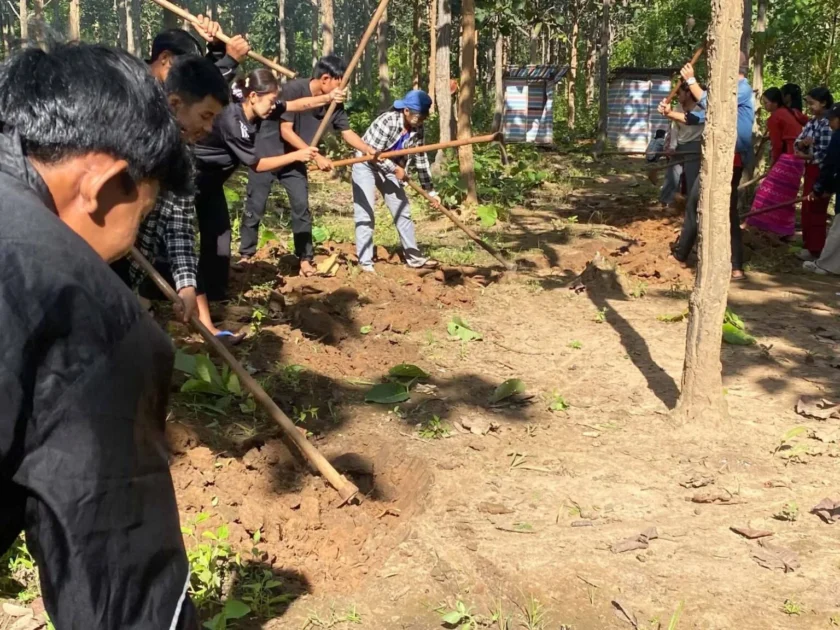
Schools have been forced to close because of military conditions, while some classes are being conducted in forests. Examinations are also delayed due to the region’s military and political situations. Some students have entered the workforce, while others have left the country.
Meanwhile, to address the shortage of teachers, young people with limited teaching experience are being trained and recruited to return to classrooms.
However, after gaining teaching experience, some of these trained teachers eventually leave their positions again because of financial difficulties.
These problems are not happening alone; rather, they are interconnected challenges affecting the entire education system, linking students, teachers, families, examinations, and higher education.
The IEC says that instead of requiring all students who have left school to return through a single pathway, it is necessary to create different educational opportunities that reflect their individual circumstances.
But the questions remain:
Will young people like Pasqualina, who have left school, ever be able to find their way back into the education system?
And as both students and teachers continue to leave, where can the broken links in Karenni’s education system be reconnected?