




Kantarawaddy Times
As dawn breaks and birds begin singing in the morning, the sound of school bells once again echoes across the forests like a melody.
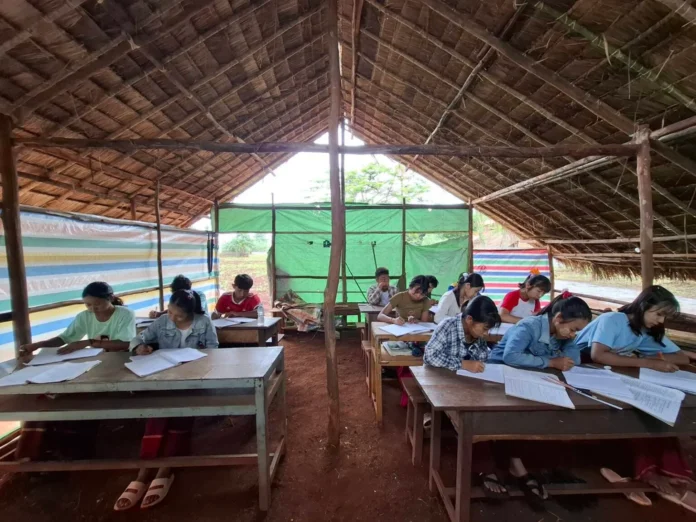
Recently, the sounds of children reciting lessons and teachers instructing in classrooms had once again come alive. But these are not the sounds that once came from school compounds at the center of villages before the military coup.
Instead, they come from makeshift schools hidden deep in the forests, built in temporary shelters far from public view. The reopening of schools does not mean that education has returned to normal.
Due to the consequences of war, teacher instability, children dropping out because of livelihood pressures, and blocked transportation routes preventing teaching aids and supplies from reaching schools, the path to education for the academic year of 2026-2027 has been made difficult. Many schools are still unable to receive much-needed stationery, teaching materials, and classroom supplies because roads remain inaccessible.
As a result, schools are relying on whatever resources they had left from previous years, sharing and reusing old materials. This has also created another challenge for teachers. In some schools, a single textbook must be shared among three or even five students during lessons.
“I stopped attending school since the COVID-19 pandemic. Later, I returned, but because I missed so much time, it was difficult to catch up with my studies. On top of that, there weren’t enough textbooks. It became difficult to keep up with new lessons in class, so I had to work much harder than everyone else,” said a female student attending a high school in eastern Demoso Township.
At present, there are 30 basic education schools in operation in eastern Demoso Township. More than 3,400 students continue their education despite numerous hardships, supported by over 300 teachers who remain committed to guiding them through this challenging journey. Yet the needs remain far greater than the number of schools available.
“In this 2026–2027 academic year, due to deteriorating road conditions and travel difficulty, there has been no educational project support arriving compared to the previous years. Thus, everything becomes much more difficult,” said the Township Education Officer of eastern Demoso Township.
Meanwhile, volunteers who have dedicated themselves throughout the revolutionary period are facing challenges in sustaining their own livelihoods. Financial hardship has led to constant turnover among volunteer teachers.
“As the revolution drags on, teachers have been changing more frequently. This instability of teachers greatly affects children’s learning,” the Township Education Officer added.
At this critical time, while people of all ages continue contributing to the revolutionary movement with determination, the Township Education Officer also urged the public to strengthen their commitment to supporting education.
At the same time, most local residents and internally displaced families are struggling just to meet their daily basic needs. As a result, many parents can no longer devote the same amount of time and financial support to their children’s education as they once could.
A teacher serving in eastern Demoso Township said that amid the many challenges, maintaining a stable teaching workforce has become one of the education sector’s most urgent needs. Ensuring that students have access to basic stationery and learning materials is equally important.
Although students have been able to return to school, shortages are not the only challenge they face. Since the military coup, students have experienced airstrikes, artillery shelling, and repeated displacement due to military operations while attending classes. Those experiences continue to leave many children fearful of going to school.
Because military forces have repeatedly targeted schools, many children continue to worry about their safety, while others are suffering from lasting psychological trauma.
For that reason, simply providing classroom instruction is no longer enough. Rebuilding children’s emotional well-being has become just as important.
“We need to encourage students as much as possible, especially those in high school. We are already doing that, but we need to do it more often. Whether it’s education officials or leaders from different departments, if they could meet with students and organize talks or discussions about why education is so important for their future, the children would come to realize that education still matters,” the teacher said.
Although reopening schools is an important first step toward restoring education, the return of school bells alone is not enough to guarantee that every child can continue learning without interruption or receive a quality education.
The voices of students reciting their lessons have returned, but under the shadow of war, the journey toward education remains difficult and uncertain for teachers, parents, and students alike. To keep that journey moving forward, sustained support and cooperation from local communities, education authorities, humanitarian organizations, and society as a whole remain indispensable.