




Saw Eh Kanyaw
When the sound of a car horn, “beep, beep,” echoes through the village center, people will carry their water buckets toward the source of the sound. They cannot afford to be late. If they miss it, they will lose something that could last nearly a week for their households and small huts. It is water.
As the cool season ends and the hot season begins, with temperatures gradually rising, water becomes the most essential need for these communities.
Across Karenni State, water scarcity has been a recurring challenge year after year.
“Water is the hardest thing for us. We have to use it carefully. When we have young children, we need to wash clothes every day. We can’t afford to buy water, so we have to treat it like gold and use it carefully,” said Daw Sel Myar, an internally displaced person (IDP) living in the western part of Demoso Township.
Because of the shortage, displaced people reuse water in every possible way by using laundry water again for flushing toilets or watering plants.
“I come from a place where water is abundant, so conserving it is very difficult for me. Before, I used two buckets for bathing, but now I have to manage with just one. After washing clothes, we reuse the water for plants or toilets. We have to recycle everything,” said Ma Shwe Sin, another displaced person.
Across Karenni State, the severity of water scarcity varies, and the cost of buying water also differs. In the western part of Demoso Township, a 1,000-liter tank costs about 15,000 kyats, while a 3,000-liter water truck can cost up to 45,000 kyats.
Near the Shan–Karenni border in Moebye, some IDP camps face shortages and must pay around 20,000 kyats per truck.
In contrast, water is even scarcer and more expensive in IDP camps west of Hpruso Township. There, a 1,000-liter tank costs about 50,000 kyats, and a large 6,000-liter truck can cost up to 300,000 kyats.
These are the prices for the end of winter and the transition to summer. Costs are expected to rise even further as summer approaches.
In western Hpruso, displaced people prioritize water mainly for drinking and cooking rather than washing or bathing.
“We don’t have water sources here, so it is very difficult. Even when we fetch water, it’s not enough. We have to carefully manage how many liters we can use each day for personal hygiene. There’s not enough for washing clothes or bathing. Thus, we mainly fetch water just to drink and cook,” said U Hla Chay, an IDP from the area.
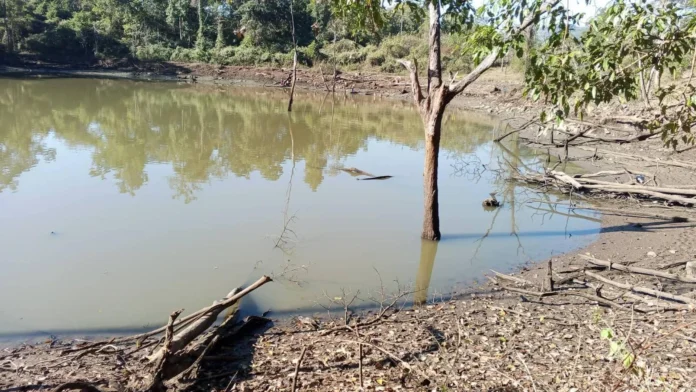
As the hot summer gradually approaches, water sources are gradually drying up. Both displaced people and local villagers have begun restricting the use of water pumps and limiting how much water individuals can collect.
Some residents in Hpruso Township must travel at least one and a half hours just to reach a water source. Transporting water by small motorized vehicles increases costs even further.
“It takes about an hour and a half. The road is tough, rocky, and uphill in places. It’s not in good condition, and we need at least a gallon of fuel for one trip,” said another displaced person fetching water.
Locals say that this journey leads to one of the few remaining water sources. If it dries up, they will have to travel even farther, which can be up to three hours, to find water.
Many IDPs use makeshift reservoirs made of tarpaulin, which are easily damaged by rodents.
“Right now, most of us can’t build proper concrete tanks. We rely on tarpaulins to store the water. In some houses, rats chew through the walls, and after three or four months, they wear out. Even a small hole causes water to leak, and repairing it is difficult,” said Ma Shwe Sin.
For displaced people who lack jobs and income, buying water or even tarpaulin is extremely difficult.
Health Impacts of Water Scarcity
The impacts of water scarcity go beyond inconvenience. IDPs also suffer from health problems linked to a lack of water.
“Water is the basic need. Without it, our health suffers greatly. When we can’t maintain personal hygiene, we experience illnesses and skin irritation,” said U Hla Chay.
Both adults and children are increasingly suffering from skin diseases due to limited water.
“At first, it starts with just one itchy spot. But when you scratch it, it spreads. We go to clinics and use medicine, with both topical and oral,” said Daw Aye May, who is experiencing severe itching.
She added that despite taking and applying medications, the condition doesn’t completely go away.
Skin problems caused by water scarcity affect not only adults but also children.
Psychological and Social Impacts
The itching doesn’t stop there. It also affects the mental well-being of displaced people, creating insecurity and interfering with their daily activities and work.
“When I go to meetings, I feel embarrassed when others look at me. At night, the itching is unbearable. I keep scratching and applying medicine. It helps a little, but when it runs out, the itching comes back. I feel ashamed. My hands are also not clean. Even contact with water or smells, like when handling livestock, makes it worse,” said another displaced person suffering from itching.
Because of these conditions, some feel uncomfortable participating in community activities, such as cooking during food donations or attending meetings.
In these difficult times, when people lack so many basic necessities, even something as natural as water has become as precious as gold. As the hot season approaches, displaced people and local communities in Karenni State will continue to conserve every drop, while enduring the growing burden of water scarcity and its consequences.