




Htwe Reh / Kantarawaddy Times
The United Nations World Food Programme (WFP) warned on December 11 that around one million people in Myanmar are in need of life-saving humanitarian assistance and could reach emergency levels of hunger. In addition, the WFP stated that more than 12 million people in Myanmar may experience hunger in 2026.
Thus, a question arises for Karenni State, which has a population of only around 300,000. Could Karenni people also face food shortages next year?
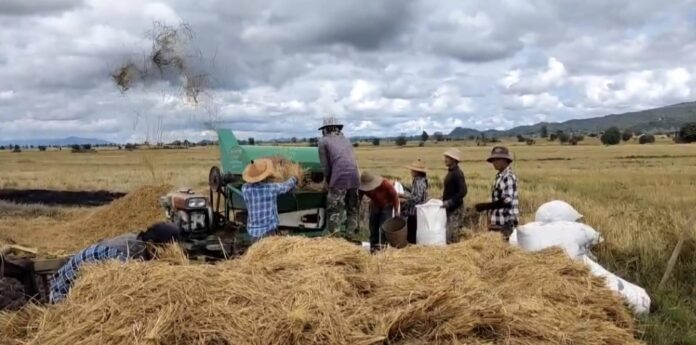
According to data collected in 2025 by the Department of Agriculture, Livestock, and Irrigation under the Interim Executive Council (IEC) of Karenni State, a total of more than 36,000 acres of farmland were cultivated in five townships, such as Pekhon, Nanmekhon, Loinanpha, Kaylyar, and Deebhaungkhu. Compared to 2024, the cultivable area has decreased in 2025.
“The first main reason for the decline is flooding. Last year there was flooding, and this year some areas were flooded again. Farmers in these areas no longer dare to plant because they face significant losses year after year. Another reason is the military’s offensive. When fighting approaches, farmers are afraid to plant. These two factors are the main reasons for the reduction in cultivated land,” said Ko Tint Swe, Deputy Director-1 of the IEC’s Department of Agriculture, Livestock, and Irrigation.
In 2025, local people on the eastern side of Pekhon Lake were unable to harvest their summer rice crops due to military offensives by junta forces and allied PNO troops. Moreover, as residents were forced to flee, they were also unable to plant monsoon rice.
In farmlands west of Loikaw Township, which border Demoso Township, farmers are also unable to farm due to security concerns. Some even take great risks to plant in the fields near villages, but unfortunately, they are no longer able to harvest these fields because of the junta’s targeted attacks on civilians.
At a time when rice is critically needed for food security, the cultivation rate has fallen by more than half compared with previous years, said Sayar Banyar, IEC Secretary-2.
He warned that due to reduced production, food supplies for the state’s population could become a serious concern in 2026.
“In 2026, there is a possibility of a food crisis. Based on the scale of cultivation, the number of people relying on locally produced rice, and the amount of rice produced this year, it is fair to say that we are facing a food security risk,” Sayar Banyar said.
Since the military coup in 2021, nearly two-thirds of Karenni’s population has been displaced by fighting and junta offensives. Many have survived for more than four, almost five years, without a stable income. Apart from relying on donors for aid, they can only address their livelihoods through small-scale subsistence farming.
In 2025 alone, more than 5,200 acres of farmland were lost due to natural disasters and junta actions. These included landslides caused by earthquakes, flooding of fields after the junta released water from the Moebye Dam, and crop damage from heavy rains.
A woman from an IDP committee living in eastern Loikaw shared her concerns, “Especially because the junta not only advances ground troops but also frequently uses heavy weapons and aircraft, we face challenges at every stage, such as planting, harvesting, and selling crops. Crop prices are extremely low, while commodity prices and transportation costs are very high. This has made life much harder for displaced people. If things continue like this, food security will be a serious concern in 2026.”
In 2025, many IDP camps across Karenni State have been facing food shortages. As military operation intensifies, the needs and challenges faced by displaced communities continue to grow.
“Lately, food shortages are occurring in almost every camp. The number of affected families has increased significantly, from ten or fifteen households to even more. In the past, we rarely heard about food shortages in many camps. But now, we hear about them frequently. The number of affected households and individuals is increasing. This suggests that the situation could become even worse in 2026,” Sayar Banyar added.
With current agricultural production levels in 2025, meeting the livelihood needs of displaced people in Karenni State has become a serious challenge.
To address food needs within the state, reliance on imported food from outside has reached as high as 35 percent, according to Sayar Banyar.
The WFP aims to provide humanitarian assistance to 1.3 million people out of the more than 12 million in need in 2026, requiring an estimated USD 125 million in funding.
A woman activist working on IDP issues in Karenni State shared her perspective on food security in 2026, “If the military situation continues like this in 2026, food needs for the people of Karenni State could become even more concerning. In previous years, displaced people were still able to cultivate crops wherever they settled to support themselves. This year, however, they don’t even have the chance to harvest what they had planted. Farmers are being attacked daily by drones, and many civilians have been injured. That is why I believe food insecurity will be among the most serious concerns in 2026.”
Currently in Karenni State, junta forces have carried out drone bombings against farmers engaged in agricultural work, resulting in at least four deaths and eight injuries. According to records compiled by Kantarawaddy Times, these attacks mostly took place in Hpruso and Demoso townships.