




Kantarawaddy Times
For most people in Karenni State who have been forced to flee their homes because of war, security has always been the top priority. Surviving amid armed clashes, heavy and small-arms fire, airstrikes, drone attacks, and landmines is the most urgent concern.
While people struggle to meet these priorities, other less visible issues gradually take root in their lives. One of them is a health-related skin disease.
Because skin diseases do not usually pose an immediate threat to life, they are often neglected.
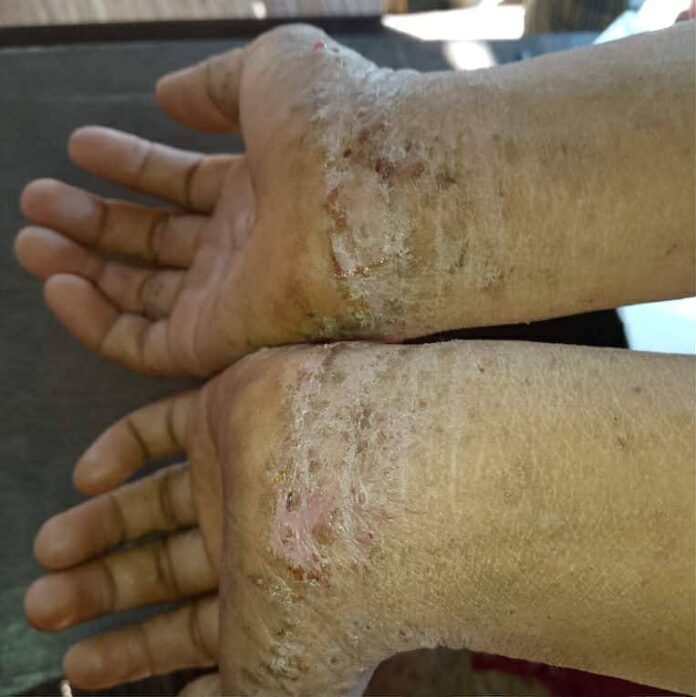
Itching, rashes, and sores are everyday health problems seen in displacement camps across Karenni State.
In the early stages of displacement, most IDPs were unable to live safely in shelters with proper roofing and protection. They had to sleep temporarily on the ground, using leaves and tarpaulins as makeshift bedding and cover.
According to local residents, these living conditions led to direct contact with unclean soil and insects, which is how skin problems began. In addition, during the period before settlements became more stable, people were often unable to bathe or maintain personal hygiene, which further contributed to the spread of skin diseases.
Even after gaining access to temporary shelters in IDP camps, skin conditions have gradually worsened due to the lack of sufficient clean water and the absence of basic hygiene supplies.
Ongoing Need for Medicines to Treat Skin Disease
At present, many people, including infants under one year old, children, youth, and adults, are suffering from skin diseases in Somo Prehsoeleh (Shardaw) Township. Due to insufficient medical supplies, displaced local communities are urgently appealing for assistance.
Healthcare workers say the disease is becoming more severe among young children who are not yet able to maintain personal hygiene on their own. In many cases, skin infections that begin on the face, hands, or feet spread across the entire body. The rate of transmission is also very high.
A healthcare worker providing treatment in Somo Prehsoeleh (Shardaw) Township said, “The absence of doctors is the most difficult challenge.”
As skin diseases become more prevalent during the summer, there is an urgent need for medical assistance.
Skin Diseases Affect People of All Ages
A mother living in western Hpruso Township is also facing skin irritation herself. Mothers with young children, like her, are trying to avoid direct physical contact with their children to prevent transmission. As a result, they ask others to care for their children and feed them with formula milk instead of breastfeeding.
“For adults, it’s difficult when we have to work or take care of children. But, when it itches, it’s even worse for breastfeeding mothers. We are extremely afraid of passing the infection to our babies,” said one breastfeeding mother.
In the past, during the school season, if there was an outbreak, the school sometimes had to be closed. Skin diseases have been present among displaced communities since the beginning of displacement and have now persisted for nearly four years.
“This isn’t something that lasts just one or two months. It has been ongoing since the start of the displacement. It comes and goes. But when summer arrives, it becomes the worst. In the coming days, many more people will be affected. Every year, cases increase during the hot season. We no longer have enough medicine. The cases have already started rising, which is why we need assistance,” said a healthcare worker treating skin diseases in Somo Prehsoeleh (Shardaw) Township.
On average, more than 30 patients visit the clinic daily in Somo Prehsoeleh (Shardaw) Township, and at least four of them seek treatment specifically for skin-related problems.
Similarly, in eastern Demoso Township, children, adults, and the elderly are experiencing itchy skin conditions. While people with stronger immunity and better personal hygiene tend to recover more easily, children and elderly individuals are more affected.
These skin conditions are among the hardships people have faced since becoming displaced by war. The most commonly observed symptoms resemble scabies, fungal infections, itching, and chickenpox-like rashes. The problem affects not only IDPs in camps but also revolutionary fighters stationed on the frontlines.
Can Skin Diseases Be Easily Resolved?
Although personal hygiene is essential for good health, for most displaced people in Karenni State, who are struggling daily just to secure food, clean water, soap, and the ability to wash clothes are not priorities they can afford. Many townships in Karenni State have long faced chronic water shortages, even before the conflict.
In a situation where survival must come before cleanliness, people rarely speak openly about skin-related discomfort.
Nevertheless, these persistent skin diseases continue to spread among the population.
The current outbreak should not be viewed merely as a health issue, but as evidence of the erosion of basic human rights caused by war and the military coup.
Addressing the problem requires more than hygiene awareness alone. Only by ensuring access to clean water, medicines, and other basic necessities can the impact be reduced. As long as these needs remain unmet, the scars of war etched onto people’s skin in Karenni State will continue to deepen.