




Kantarawaddy Times
War doesn’t just take human lives; it also silently destroys people’s psychological well-being and mental health. The armed conflicts taking place in Karenni State have not only destroyed the lives, homes, property, towns, and villages of Karenni people but have also left behind deep, invisible psychological wounds among survivors. Over time, these wounds grow deeper and can affect entire communities.
Psychological Trauma Caused by War
Most people living in Karenni State face daily experiences of airstrikes, artillery shelling, and military operations. Living under these conditions leaves people in a constant state of fear, suffering symptoms of Post-Traumatic Stress Disorder (PTSD), such as insomnia, panic at sudden noises, and flashbacks of traumatic events.
PTSD is a mental health condition that can develop after experiencing or witnessing a severely traumatic event. It may occur when someone directly faces life-threatening situations, witnesses such incidents, or learns that a close person has been injured or killed. Some people are not even aware that they are suffering from trauma and continue to struggle through daily life.
Displacement and Mental Stress
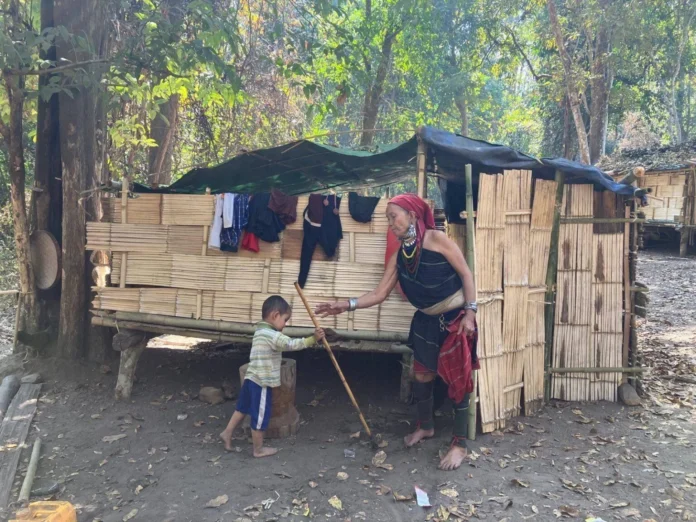
The number of families taking shelter in displacement camps and forested areas in Karenni State continues to rise. Being forced to flee one’s home is equivalent to losing one’s entire life. The loss of livelihoods, food insecurity, and uncertainty about the future intensify stress. These pressures often lead to depression, heightened anxiety, and even domestic violence.
“Since the war started, anxiety has been the biggest change in my life. Worry and fear have become part of my daily existence,” said Yay Chel (pseudonym).
Yay Chel, around 30 years old, has lived in a displacement camp for more than three years. She experiences insomnia and becomes extremely frightened whenever she hears airplane or gunfire sounds. Constant alertness has deprived her of peaceful nights and days of freedom.
Like Yay Chel, displaced people, especially mothers with children and elderly family members, live in a constant alertness in order to avoid air and artillery attacks. In this environment, they even fear falling into a deep sleep on nights when they are utterly exhausted.
Impact on Women and the Invisible Wounds of Children
For children, war destroys even a normal childhood. Sudden school closures, losing parents to conflict, and growing up in unsafe environments severely harm children’s mental health. As a result, many Karenni children grow up with fear, emotional instability, and may face social difficulties in the future.
“Especially, women and children. Children instinctively run into bunkers whenever they hear a sound. Even very young children already know how to hide. After children, women suffer the most,” explained a former health worker who served as a nurse at a mental health hospital, describing the situation she witnessed in Karenni State.
During armed conflict, women not only struggle to hold families together but also face multiple dangers, including violence, sexual threats, and the loss of loved ones. However, access to mental health support is extremely limited, and in many cases, women cannot even speak openly about their suffering.
Limited Access to Mental Health Services
Lin Lin, a member of the Bridge of Being organization, said that stress-related symptoms are the most common mental health issues among civilians and revolutionary youth in Karenni State. Her group provides mental health awareness, relaxation activities, and listening spaces for those who wish to share their feelings.
According to her observations, the main causes of stress among displaced people are livelihood difficulties, financial hardship, and the possibility of having to flee again.
Globally, around 700,000 suicide cases occur each year. Since the military coup, similar incidents have also occurred in Karenni State, which Lin Lin believes are consequences of prolonged stress and trauma.
“In recent years, we have seen more suicide cases in Karenni. In my view, these are linked to psychological trauma. This period is extremely difficult, with overwhelming stress and emotional exhaustion,” she said.
Based on information gathered by Kantarawaddy Times, there were five suicide cases in Karenni State in 2025, including one Grade-5 schoolgirl.
Among young revolutionary fighters, repeated exposure to the deaths and severe injuries, such as losing limbs, of comrades has also contributed to serious psychological distress, Lin Lin added.
In Karenni State, access to mental health services has become extremely difficult due to the destruction of health infrastructure and a severe shortage of health workers. At a time when even providing basic healthcare services is challenging, offering specialized mental health care is even more so.
A CDM nurse explained that as long as people remain in active conflict zones, it is impossible to provide genuine psychological safety.
“From a health perspective, can we provide adequate mental health services? To provide adequately, we would likely need to relocate. As long as we are in an active war zone, we cannot provide any sense of safety regarding mental health,” said the nurse.
“If these traumas are not treated, in the long term, what can happen is what we call ‘Post Trauma’- the after-effects of trauma. Long-term consequences can include auditory hallucinations, like hearing aircraft sounds even when none are present. Then there is chronic insomnia as well. The long-term danger is things like that. It’s because of the lack of psychological safety. Such dangers exist,” the nurse added.
Psychological Wounds to Heal After the War Ends
Yay Chel shared, “When we first experienced loss, no one even wanted to talk. But as time passes, I try to accept that nothing in life is permanent. Since I must start over from zero, I try to rebuild from where I am. For my children’s future, I strengthen my mind and keep moving forward.”
She currently copes by relying on her faith, speaking with religious leaders, and connecting with organizations that provide mental health support.
Social perceptions that still view mental illness as a form of “weakness” also prevent people from seeking help or services. Therefore, Lin Lin urges communities to recognize that mental health problems are not signs of weakness and to encourage those suffering to reach out for support.
Although the war in Karenni State may one day end, the psychological wounds it has caused will take much longer to heal. Rebuilding society must include mental health as a priority, just as important as reconstructing roads, homes, and schools. The true end of war is not the day gunfire stops, but the day people’s minds and spirits are able to recover.