




Kantarawaddy Times
Although the gentle spring breeze of the New Year is blowing gently, the news carried along with it also seems to bring fear and anxiety to people.
For Karenni internally displaced people (IDPs) who have been living in forests and mountains for five years, the hope that “we may soon be able to return home in the new year” is repeatedly shattered by news reports that they often see, read, and hear. However, again and again, that hope is struck down by a question: “Will I be safe?”
In the early months of 2026 alone, Karenni State has been shaken by reports of a murder on January 12, an armed robbery on January 14, and the escape of around 90 prisoners on January 18, which are the events that have overshadowed the very first month of the new year.
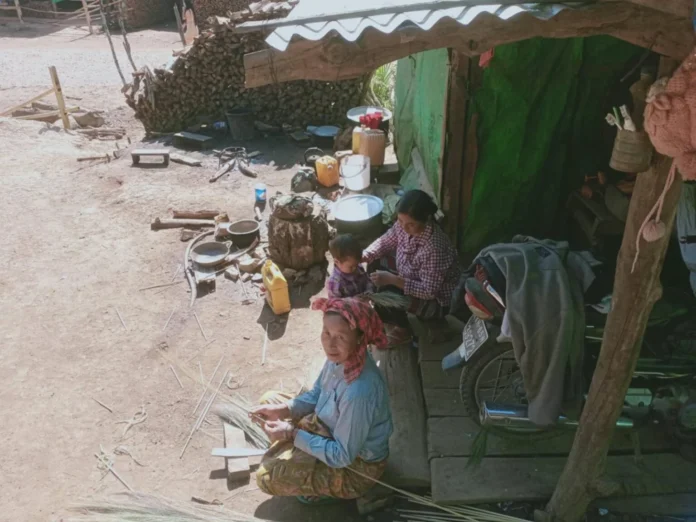
Due to these reports, Daw Mar (pseudonym), an IDP, is acutely aware of how unsafe her life has become.
Always hoping to return home with her family, Daw Mar now watches strangers on the road with suspicion. She fears that danger could come from anyone.
“Lately, I even reach the point of thinking about whether I should carry a weapon. I think that if someone attacks me, I should at least be able to fight back,” she said.
From her home, Daw Mar has to ride a motorbike for about 25 minutes to reach a place where she can access Starlink internet. Because her small trading business requires her to communicate with customers online, she must frequently travel there, but her mind always seems to remain back home.
After joining the Civil Disobedience Movement (CDM) following the military coup, Daw Mar had to leave the property and belongings behind that she had worked hard to gather for her family’s survival.
“Situation is going like that, if I leave my belongings at home, I’m afraid because I’m an IDP. But if I carry them with me, I’m also afraid of being attacked,” she explained.
Daw Mar is in her early thirties. She got married not long ago and does not yet have children.
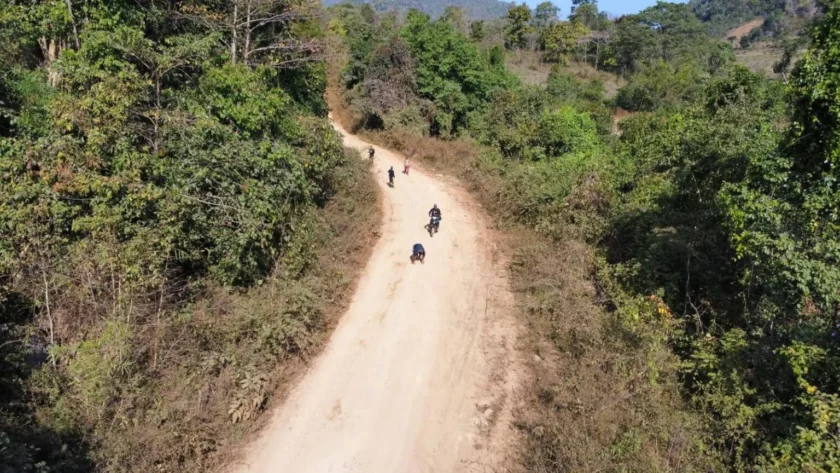
From the township where she lives, she often travels alone along a mountainous road that takes about two and a half hours to reach another, more economically active and crowded township.
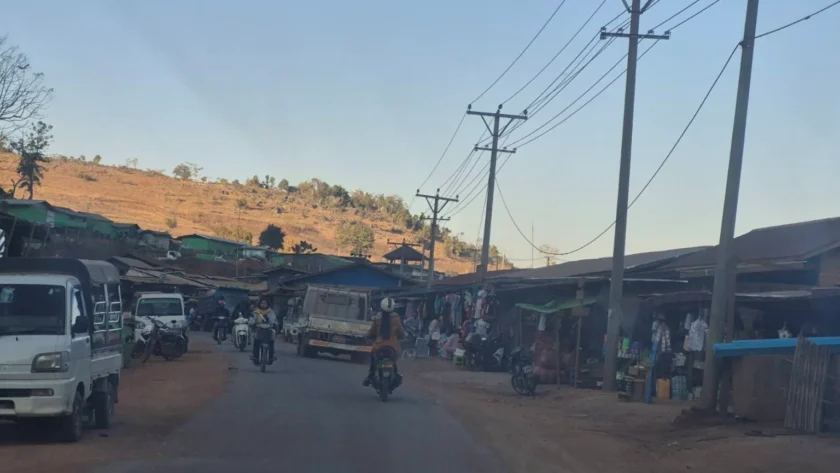
Before the coup, she could simply use the main highways. But after the coup, because of fighting, she now has to rely on forest routes.
“I’m afraid of thieves and robbers. I’m also very afraid of soldiers (junta troops),” she said.
Although the forest road she uses is said to be far from active fighting and relatively safe, it is deserted, and the distance between villages is long. Now, Daw Mar has to think twice before traveling alone.
Previously, her main concern was just to stay away from armed conflicts. Now, because of robberies and murders, she feels uneasy even around fellow travelers she meets on the road.
Even after making the 25-minute journey to use the internet, Daw Mar feels heavy-hearted when she sees young and middle-aged people actively playing online gambling games at the Starlink shop.
She believes that many of the robberies and killings in Karenni originate from online gambling.
“If laws can be enacted and truly enforced, I think we would feel safer,” Daw Mar said.
She can barely even remember the time when she once enjoyed mental and physical security under the rule of law.
However, enforcing law and order has always been difficult in ethnic regions, and it has become even more challenging during this interim period.
Most IDPs in Karenni State are struggling to survive amid rising local crime.
“During displacement, when people are exposed to drug use and unstable living conditions, that often becomes the first step toward violence,” said Maw Moe Myar, a member of the Karenni State legislative body, during a women’s discussion organized by Kantarawaddy Times.
Still, another displaced woman believes that only the rule of law can truly guarantee her safety.
She has been displaced for nearly five years in western Demoso Township and defines a safe environment simply as being able to move freely.
“Being able to move freely and fearlessly. And then, to speak and express oneself freely, that’s what security means to me,” she said.
Yet administrative bodies acknowledge that restoring the rule of law after it collapsed due to the coup is extremely difficult, especially since the interim governance system had to be rebuilt from scratch and still cannot cover the entire state.
U Ba Nyar, Secretary-2 of the Karenni Interim Executive Council (IEC), said that the interim system cannot guarantee 100 percent protection from dangers that could be directed at civilians like Daw Mar.
“As the conflict drags on, political instability deepens, socio-economic conditions deteriorate, and mental and physical stress increase, crimes and challenges to the rule of law are bound to increase. We accept this reality,” he said.
Crimes are being investigated jointly by the Karenni State Police (KSP) and relevant armed groups controlling specific areas.
According to KSP’s four-year report, they are handling cases related to junta-related offenses, murder, rape, robbery, theft, drug trafficking and abuse, assault, property destruction, and domestic violence. However, it is not easy to obtain detailed information or speak directly with KSP.
KSP has also stated that, even after four years of existence, it still needs manpower and arms to effectively cover the entire state.
As a result, Daw Mar and many other displaced women like her are increasingly focused on how to protect themselves in a context where the rule of law remains weak.
During the five years of continuous conflict since the coup, Daw Mar has survived by constantly being alert to threats from heavy weapons, drones, airstrikes, shootings, and landmines.
Now, she says she must also plan how to avoid harm amid the insufficient law enforcement under the interim government.
According to data obtained by Kantarawaddy Times, there were five murder cases in Karenni State in 2025. Including one case in early 2026, the total is now six, three of which involved women. The actual number may be higher due to unverified cases.
Since the 2021 coup, domestic violence, robberies, and home break-ins, which have surged due to socio-economic crises, are also ongoing, unforgotten issues in Karenni.
After the coup, Karenni has been recognized by international communities as a state attempting to build a bottom-up federal system, which strengthens the state first as the foundation for a strong federal union.
When Daw Mar says firmly, “Nowhere is safe,” it reflects her fear of being permanently separated from the people she loves.
Although Karenni is geographically one of the smallest states in Myanmar, it hosts more than five armed organizations and groups. They participate in the IEC administration through a proportional system, and each also maintains its own administrative structures in the areas it controls.
Like Daw Mar, many civilians believe that having too many governing authorities in one state creates serious challenges for the rule of law.
However, the displaced woman from western Demoso still wants to believe in this collective governance.
“Every organization has its own authority and responsibilities. If they respect one another, cooperate, and stay united, I think civilians will eventually feel safe,” she said.
Reducing the subsequent anxieties caused by the current weaknesses in the rule of law experienced by the Karenni people also depends on the management of the interim government.
At a time when ordinary people like Daw Mar are primarily struggling just to survive and meet daily needs, who would not want a safe life?
With these dreadful crimes continuing to occur, whenever Daw Mar needs to travel outside, she now feels she must find a companion to accompany her for her own safety.
