




Khu Htwe Reh / Nan Kham Ku
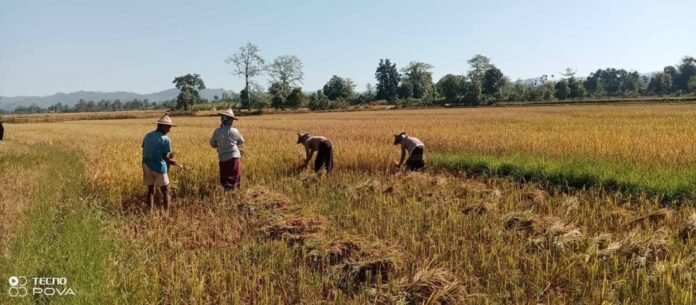
On a cool October morning blanketed with mist, four young farmers are hurriedly harvesting rice in the fields.
They keep glancing upward and looking around anxiously while they cut the crops. Bundles of harvested rice stalks can be seen on both sides.
Local residents are harvesting in fear because if they encounter soldiers from the junta’s columns, people harvesting rice are often arrested without reason.
Since the 2021 military coup, gunfire has continued to echo across Karenni State. Due to constant military offensives and frequent clashes on the ground, farmers’ ability to cultivate has gradually declined.
But that is not all. As time goes on, farmers are bearing the worsening impacts of climate change.
“Because of climate change, IDPs can no longer farm. When it rains heavily, the fields flood. Farms are destroyed. Crops that were already planted are also ruined. These are the hardships many displaced farmers are facing,” said a displaced woman farmer.
In August 2024, floods, landslides, and unseasonal heavy rain across Myanmar, including Karenni State, destroyed a lot of acres of paddy fields.
Displaced communities affected by both war and climate change now struggle daily for food. They prioritize feeding the elderly and children, and there are even days that families survive only on rice porridge.
“In the past, when we had donors, it was manageable. But now, donors are gone. We have to struggle on our own. Every day I worry about how to find enough food. Some days we only have rice porridge,” a displaced mother said with a sigh.
She added that harvesting takes longer than planting, and clashes have increased during this harvesting period. Farmers are terrified because the military has arrested and even killed some who attempted to harvest their fields.
In the Shan-Karenni border areas, such as Pekhon and Moebye, farmers harvest rice amid the sound of gunfire. People there depend on cultivating upland rice and various crops for their livelihood.
Moebye and Pekhon, once peaceful areas that resembled a natural painting with their paddy fields and diverse crop plantations, were plunged into misery on February 1, 2021, by a power-hungry group. It was the day the military began introducing not only fear but also hunger.
For farmers in these areas, the Moebye Dam is their lifeline for rice cultivation. But the military controls the dam. Locals fear that soldiers may intentionally release water from the dam at any time.
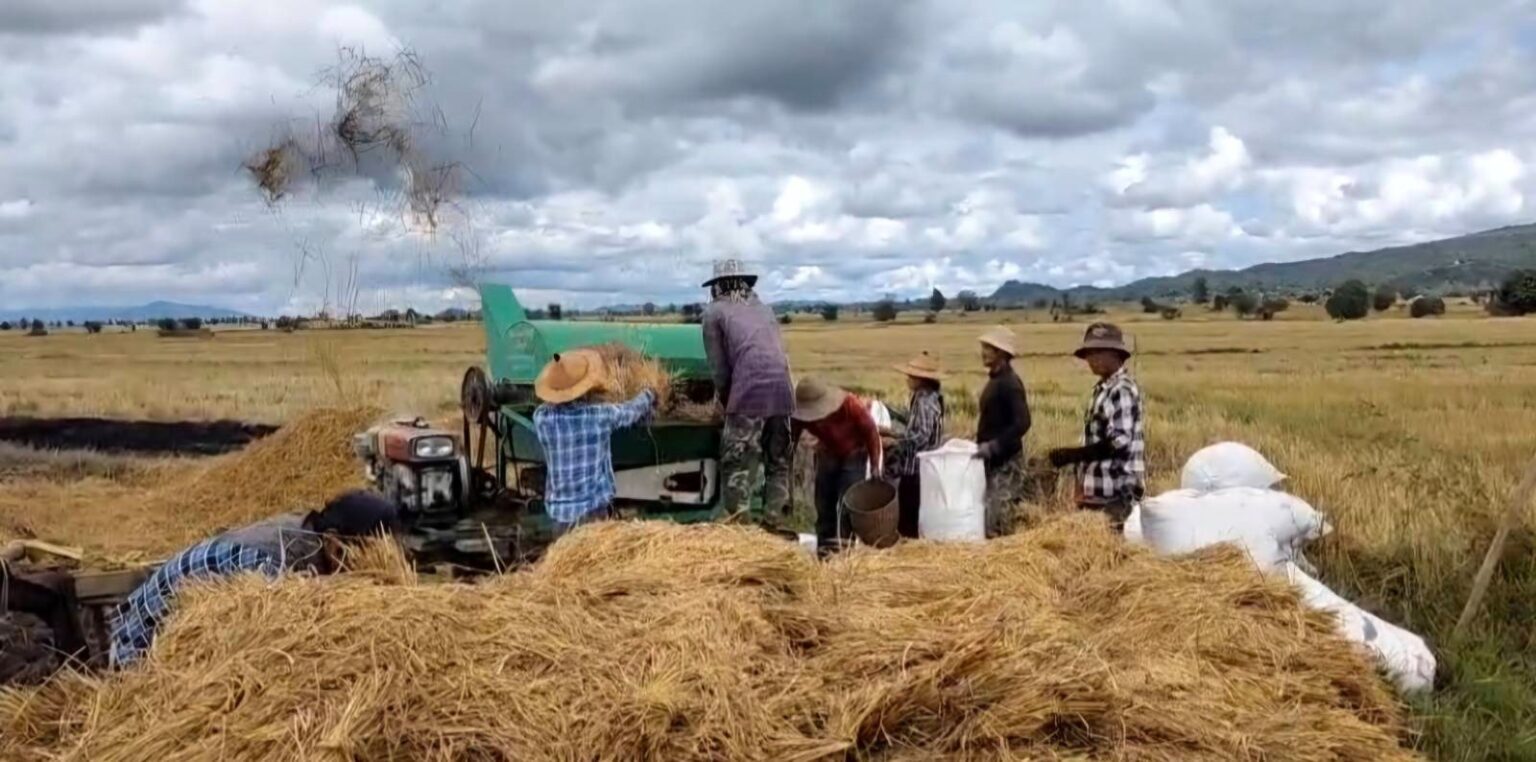
In the second week of August 2025, the military intentionally released water from the Moebye Dam, which is under their control, submerging nearly 600 acres of farmland below the dam.
Between 2024 and 2025, thousands of acres of farmland were lost due to both climate impacts and intentional dam breakage by the military.
When farmers need irrigation for their paddy, the Moebye Dam doesn’t often release water adequately. But due to unseasonal rains and climate irregularities, the dam also overflows unexpectedly.
In addition to climate change, because the military breached the Moebye Dam, thousands of acres of paddy fields were flooded, and farmers faced massive losses. They must now endure not only natural disasters, but also human-made ones.
By 2025, the cultivable farmland area in Karenni State had fallen by 14 percent.
According to the Interim Executive Council (IEC) of Karenni State, the five townships (Pekhon, Debownku, Nanmekhon, Loinanpha, and Kaylyar) have more than 36,000 acres of cultivable farmland.
Due to natural disasters and military offensives, over 5,200 acres have been completely lost, said U Tint Swe, Deputy Director of the IEC’s Agriculture, Livestock and Irrigation Department.
Regarding the main reasons for the decline in agriculture this year, U Tint Swe further explained, “the first reason is the flooding. Last year, many fields were flooded, and some were flooded again this year. Farmers in these areas no longer dare to plant because year after year, the losses keep increasing. The second reason is military offensives. When the army comes near, farmers are afraid to plant in those areas. These two factors are the main causes of reduced farmland.”
With cultivation gradually decreasing like this, ensuring sufficient rice and food supplies for IDP farmers in the coming year is a major challenge.
During the revolution, IDPs relied on donations and also tried to plant small-scale gardens of gourds, cucumbers, and other vegetables. But when the time comes to harvest these small crops, they again face military threats.
Currently, according to IEC records, there are around 250,000 displaced people and about 450 displacement camps in Karenni State.
“With the losses increasing like this, next year it will be a major challenge for our people to meet their food needs,” U Tint Swe explained regarding food security for 2026.
Right now is the rice-harvesting period for displaced farmers. But their biggest challenge is not the harvesting itself; instead, it is the danger from military drones and heavy artillery launched by the junta.
Because the military uses drones to target civilians in Karenni, three people were killed, and eight were injured, during October alone.
By November 18, another person had been reported injured, according to records from Kantarawaddy Times.
“Maybe it’s also because of the weather. Heavy rains kept coming, so we harvested late. But now, when we try to dry the rice, the sun doesn’t come out. This is another challenge. When the sun doesn’t shine at all, the rice goes bad,” U Nyar Reh, a local farmer, said.
Farmers face both military attacks and natural disasters. Heavy unseasonal rains make it difficult to dry the rice they manage to harvest.
Environmental experts say that to reduce the impacts of climate change, more trees must be planted and protected, rice storage systems improved, and indigenous plant varieties preserved.
“As the saying goes, ‘the climate depends on the forest.’ We must grow and protect trees. Climate change is reducing people’s food security. We should plant more trees, not for selling, but for water sources. If individuals make changes, things will improve,” one environmental analyst said.
Caught between war and natural disasters, displaced civilians struggle to survive. They also long for peace and justice, and pray each day to escape hunger.
“I just want the war to end. I want the days of hunger to be over. I don’t want to live with fear and trauma anymore,” said a displaced woman, her voice trembling.