




Kay Du / Kantarawaddy Times
“When it comes to future generations, education is the foundation. In this current situation, beyond whether the quality of the education is high or low, what matters most is making sure that every child does not lose their right to education. This requires teachers, parents, and students to move forward together. Sadly, some children are already losing their right to learn for various reasons.”
These are the heartfelt words from a parent in Karenni State, where the fight against the military dictatorship remains intense.
Whether it is a country or a state, education plays a central role in building it. Education can be called the very foundation of a nation.
Yet, since the military coup more than four years ago, this crucial sector has been gradually deteriorating. In Karenni State, where revolutionary forces are strong and the junta targets them heavily, the younger generation is losing educational opportunities.
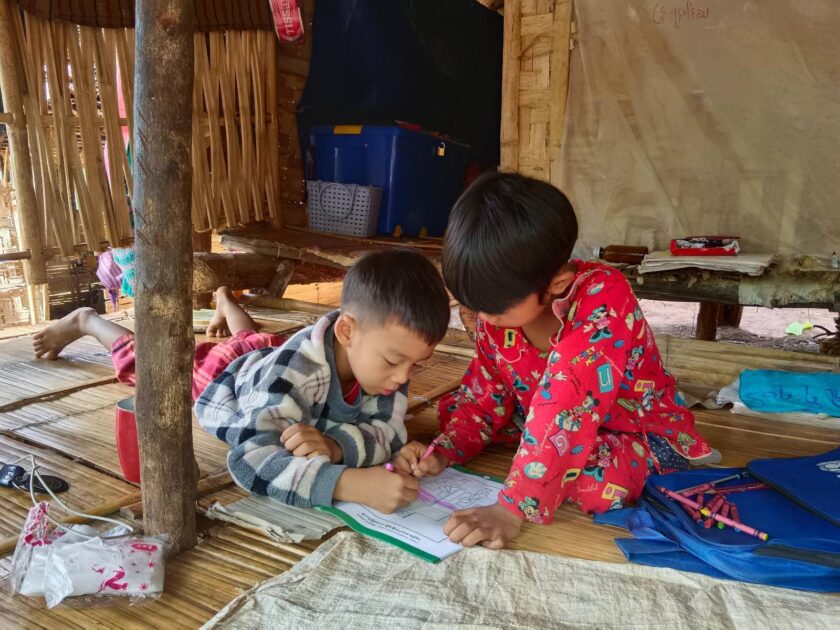
Children in Karenni State Losing Access to Learning
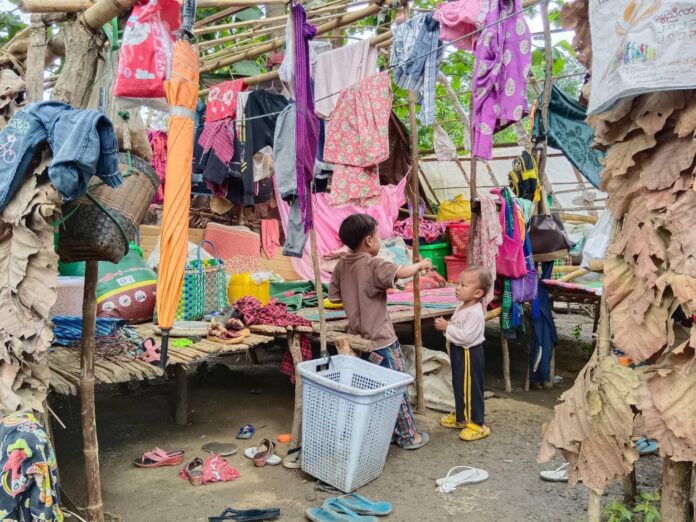
In Karenni State, daily clashes continue between junta troops and local revolutionary forces. Therefore, many school-age children have had to flee with their families into the forests and mountains. They are just continuing their learning in whatever way and with whatever resources they can find.
Amid these hardships, children face many challenges. Some have dropped out entirely because of their family’s financial problems.
Under the constant threat of junta airstrikes and heavy artillery, daily survival is a battle. Many children now bear deep psychological scars from the trauma of war and displacement.
In June 2025, there was an incident in which one fifth-grade girl, overwhelmed by the weight of these challenges, took her own life. This tragic incident highlighted the severe difficulties that students and parents striving for education are facing in Karenni State today.
Moreover, when gunfire is heard during class, students and teachers alike are gripped by fear. Though schools have dug hiding trenches for safety, these cannot protect against the junta’s 500-pound bombs.
On February 5, 2024, the junta carried out an airstrike on Daw Si Ei Middle School in western Demoso Township, killing four students and injuring twenty-nine others. With such targeted attacks, schools often close temporarily for safety reasons.
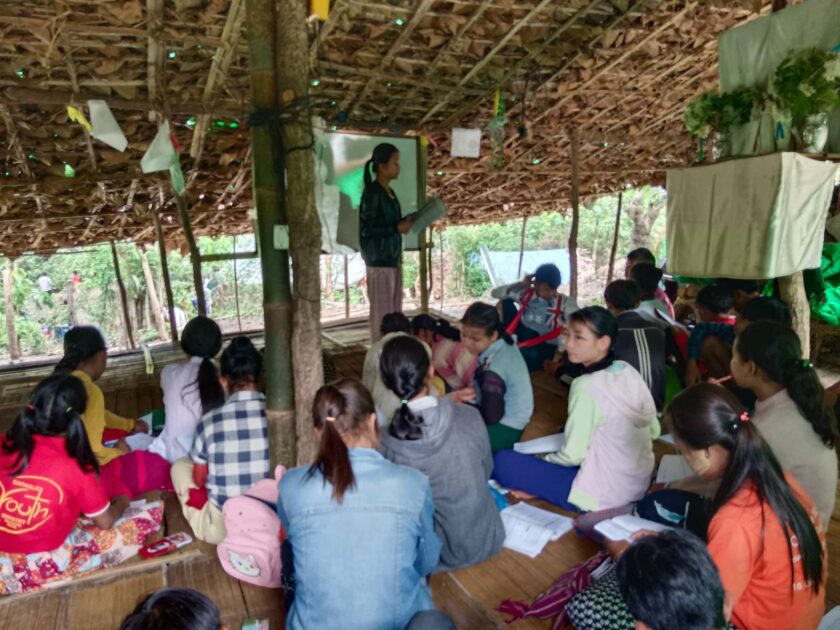
In one high school built deep in the forest using bamboo walls and tarpaulin roofs instead of bricks and tin, a student named Ma Soe Lin Thwel shares her worry for the future.
“With this situation, I’m not sure teachers will be able to hold on in the coming years. Everyone, no matter whether they are teachers, students, or security guards, faces different challenges,” she said.
On top of security concerns, schools also face severe shortages of teaching and learning materials. Many are self-funded community schools, so it is hard to meet all their needs.
“I’ve seen that a lot of schools operate on their own. Teaching materials are insufficient, and there aren’t enough resources for teachers. Naturally, the education in these schools will have many gaps,” said a high school graduate.
Still, another recent high school graduate expressed hope that even though many schools are community-based, there are still many skilled and talented teachers. He believes that in the future, they will nurture quality, capable young stars for our community.
How Are Teachers Teaching in the Conflict Zone?
In terms of teaching, there is currently not a single school that has enough teaching materials or adequate resources. Revolutionary teachers are using every possible method and every bit of knowledge they have to teach their students. In situations where CDM (Civil Disobedience Movement) teachers are insufficient, many volunteers have stepped in to help.
Some of these volunteer teachers are highly qualified, while others share their work experience and teach from what they know. To help volunteers develop into more capable teachers and ensure educational quality, they are trying their best, according to Soe Hlaing Win, the Director of the Basic Education Department under the Education Department of the Karenni Interim Executive Council.
“Especially, we have reopened local education degree colleges and organized training programs to improve teacher quality. In the future, our focus will be on guaranteeing quality in education, so there will be improvements,” he explained.
In one self-reliant school in Demoso Township, which has been running up to high school level since the coup, there are 14 teachers who are currently teaching more than 200 students. Among these teachers, only three are CDM participants. The remaining 11 are volunteers, and only one of them has ever attended training provided by the authorities, according to a school headmistress.
In most schools, the number of CDM teachers is not enough, so volunteer teachers are being recruited. However, according to the Education Officer of the Karenni IEC in Somo Preh Soe Leh Township (Shardaw Township), if only experienced CDM teachers were chosen, there would not be enough teachers to meet the needs.
“Right now, what we see is that parents push for schools to open. They want qualified teachers. But they often don’t see what the school needs, how they can help, or how to support the teachers. As a result, volunteers teach for a year, leave, and new ones come in. That’s why this cycle repeats, and there’s no improvement in quality. If teachers received more support and help in areas where the school needs it, they would be more motivated and committed. Over time, they would gain experience, and the qualified teachers that parents want would emerge,” the education officer of Preh Soe Leh Township explained.
What are Parents’ Concerns and Hopes for the Future?
Given the current situation in Karenni State, efforts are being made to prioritize education so that school-aged children do not lose their chance to learn. Some parents also hope for a fully functioning, high-quality education system.
However, whether children achieve strong educational skills and quality learning depends heavily on the country’s political situation as well. Parents fear that without a solid foundation in education, their children will face difficulties in the future.
“The foundation is the most important. Without a strong foundation, the future will be difficult. Even though those in charge are doing their best now, we hope they will do even better so that all children can have access to education,” said one parent.
But even during lesson times in the forest or mountains, health concerns, safety fears, and constant anxiety have remained major obstacles.
Schools in conflict zones that are frequently targeted by the military often have to close for safety, and these frequent closures reduce children’s interest in learning.
Some children, constantly moving from place to place, are unable to complete their school year. As they grow older, many lose the desire to return to school.
In some cases, schools push children into higher grades using short-term “fast-track” programs, just so that they can be promoted. But parents worry that this causes students to fall behind academically and harms their future education.
“As displaced children grow older, some schools promote them quickly using two-month or six-month plans. But this means they can’t keep up with their studies. Teachers’ stipends are inadequate, teaching materials are insufficient, and there aren’t enough textbooks. That’s why I worry about the future of these children’s education,” one parent said.
Since the military coup, nearly 600 basic education schools have managed to open in Karenni State. However, due to the current fighting, all basic schools have now been shut down. These frequent closures for security reasons have only deepened parents’ fears about the future of their children’s education.