





Maw Oo Myar / Kantarawaddy Times
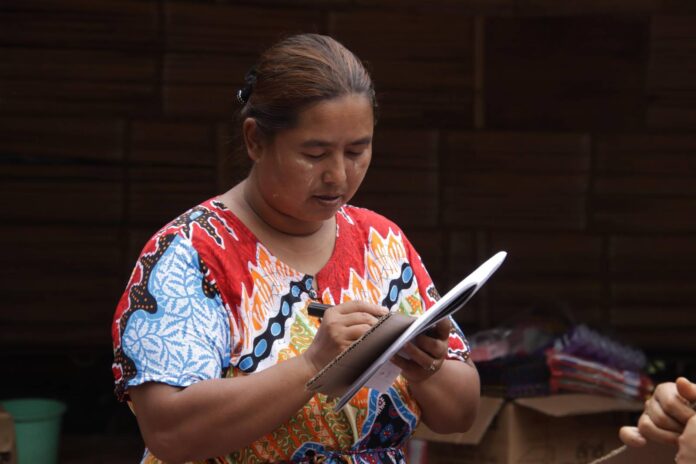
Daw Nan Su Su Lwin is a female administrative leader overseeing two IDP (internally displaced person) camps and three villages, collectively home to around 3,000 people.
She is trying to produce 70 women leaders in the camps and villages that she is managing by empowering them to take on leadership roles like herself.
Daw Nan Su Su Lwin is 46 years old and is the mother of a teenage son and daughter. Like many others, her family has been displaced by the war. Over the past two years of displacement, she has taken on leadership roles, doing whatever she can to support fellow displaced people.
While some are on the frontlines defending the country or fighting back against military rule, she believes those who remain behind must also take up their own forms of responsibility. For this reason, she has taken the initiative to lead, bringing other displaced women along with her.
Throughout her leadership, she has had the full support of her family. “My husband never opposes what I do. His only concern is that I’m a woman. That’s the only worry. Otherwise, everything is on my feet,” she shared.
She doesn’t let her free time as waste. Instead, she organizes and leads recreational activities, like games, to provide emotional support for displaced children and the elderly.
Her family lives in the camp alongside others, sharing difficulties and solutions together. This spirit of communal care is something Daw Nan Su Su Lwin herself actively fosters. Because of her leadership, everyone from children to the elderly in the camps tends to follow her guidance, which, in turn, motivates her to lead even more.
However, what weighs on her constantly is fear, not due to the current situation or crisis, but simply because she is a woman. She admits that being female often influences as a shadow over her role and confidence as a leader. This fear intensifies when she must personally address difficult or sensitive issues.

“It’s because I’m a woman,” she said. “That fear comes with being female. That’s all it is.”
Daw Nan Su Su Lwin serves as the group administrator for a population of roughly 3,000, but the official chairman of the administration is a former soldier who lost a leg after stepping on a landmine during the battles. She personally invited him to join the leadership team.
“We encouraged him, saying that instead of being depressed after being injured, he could still contribute. We also reach out to other men and women injured by landmines to help out, offering them small tasks. Though the tasks are unpaid, it helps to get some joy or motivation,” she explained.
Her administration has established various committees to handle governance, local leadership, healthcare, education, religious affairs, women’s affairs, security, water access, and agricultural matters.
Apart from the security committee (which is male-led), all other committees are headed by women. However, even in the security committee, the membership is balanced between men and women due to security needs. Altogether, about 80 people participate in these committees, 70 of whom are women.
One of the female committee members described Daw Nan Su Su Lwin as a role model and said that her leadership inspired her to participate.
“They’re clearly working so hard. I just wanted to help where I can. I’ll do what I can. Of course, there are things I can’t do, but the way she leads is very impressive. If she’s doing something good, we should support her to do even better,” she said.
This woman, now 28, is a married woman from Hoyar, in Hpruso Township, and currently lives in the camp with Daw Nan Su Su Lwin.
Importantly, Daw Nan Su Su Lwin didn’t become a leader only after arriving at the camp. Even before the military coup, she had been serving as a community head in her home village. Her leadership journey has already spanned about five years.

Her village, Pantane, was later destroyed and burned down by junta forces. In 2023, the military moved in, occupied it, and burned almost every house. She was serving as the village administrator at the time.
Though her role doesn’t come with a salary or financial support, and though she’s not on the battlefield giving her life, Daw Nan Su Su Lwin continues to carry out her responsibilities with great dedication.
If her leadership brings even slight hope to displaced families and children, Daw Nan Su Su Lwin finds fulfillment. She is very motivated to continue empowering young women alongside her.
She also shared her vision for the future of her homeland, once peace is restored:
“All of us, including children and adults, are living with broken lives right now. In the future, since these young soldiers (revolutionary forces) are protecting us, even risking their lives, I also want to do as much as I can from behind, ensuring their families have a bright future.”