




Kantarawaddy Times
In the current political and administrative landscape in Karenni State, a different scene is emerging. Women are no longer just participating at the grassroots level, but are gradually taking on leadership roles and moving into positions where political and administrative decisions are made.
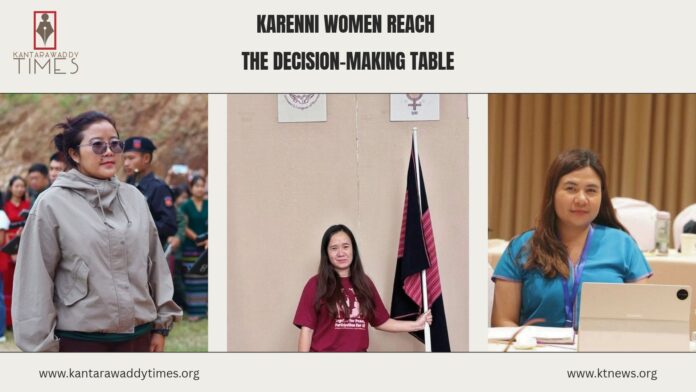
In September, Mu Angela was selected as Chairperson of the Karenni State Consultative Council (KSCC) and Maw Theh Mar was selected as Secretary of the Karenni National Progressive Party (KNPP). Notably, Maw Theh Mar became the first woman to be selected for a top leadership position in KNPP history.
The growing presence of women in leadership positions across Karenni State’s administrative, political, and revolutionary organizations, including the KSCC and KNPP, is widely regarded as the result of decades of efforts by Karenni women.
Rosie Kyaw, Director of the Women For Women Foundation (WWF), described this situation as a proud and significant milestone for women throughout Karenni history.
“As a women’s organization, we see the increasing election of women leaders and their participation in leadership roles across various administrative, political, and revolutionary organizations in Karenni State, including the KSCC and KNPP, as a proud and remarkable milestone and achievement in the history of Karenni women,” she said.
Khun Thomas, Head of the Department of Youth Affairs under the Interim Executive Council (IEC) of Karenni State, also said that women’s growing participation in administrative and political leadership is a positive development, emphasizing the importance of women’s roles.
“At a time when no other state has been able to do this, our state’s KSCC is taking the political leadership of Karenni State. I strongly support and believe in having a woman as our chairperson. I also think this is something that should happen,” Khun Thomas said.
However, women’s organizations do not consider the appointment of women to leadership positions as the end of the struggle.
What matters most is what women can actually decide from these positions and to what extent their voices are reflected in the decisions being made.
Similarly, the Steering Council for the Emergence of a Federal Democratic Union (SCEF) aims to ensure women’s participation in political power-sharing and decision-making processes. There are plans to establish a women’s representation pillar within the council.
Daw Zu Padonmar, a member of the SCEF Secretariat, emphasized that establishing a women’s pillar is not merely about creating a space for women.
“The establishment of a women’s pillar should not be seen merely as gaining a space for women. Rather, it should be understood as part of a process of rebuilding political relationships within SCEF’s efforts to establish a federal democratic system, particularly in reconsidering who holds political power and how they participate,” she said.
From the perspective of women’s organizations, women’s voices should not be limited to issues that directly affect women. Their perspectives must also be included in fundamental political matters, such as federal structure, governance, peace, and political transition.
Therefore, the SCEF women’s pillar has also highlighted the need to bring together women’s voices, engage in discussions with different women’s organizations, and develop shared political perspectives among women.
Representing women does not mean that all women must share the same views. Women come from different ethnic backgrounds, regions, organizations, and experiences, and their perspectives may differ. Daw Zu Padonmar said it is more important to discuss and negotiate to identify a common perspective rather than to eliminate those differences.
In this situation, expectations from other women’s groups regarding the newly appointed women leaders are also high.
Mu Teresa, Joint Secretary-1 of the Kayan Women’s Organization (KyWO), said women had spent more than a decade working towards reaching positions where they could participate in political, administrative, and peace-related decision-making.
“Today, we are beginning to see the results of what we have pushed for and struggled to achieve. To be frank, our expectations of the current women leaders are very high,” Mu Teresa said.
However, as expectations increase, so too does the pressure placed on women leaders.
“When I say that our expectations are high, I also mean that the women in these leadership positions will face enormous challenges. In this case, women’s groups will also need to support them,” she said.
Therefore, rather than placing the responsibility solely on individual women leaders, women’s organizations and groups need to stand behind and support them. At the same time, there is a growing view that women leaders should not be judged by different standards from their male counterparts.
The SCEF women’s pillar has pointed out that when women enter politics, they tend to be questioned more about qualifications and standards, for example, “must be qualified, must be effective.”
Therefore, the qualifications and leadership abilities of both male and female representatives serving on political leadership councils should be evaluated according to the same standards.
Mu Angela, the current Chairperson of the Karenni State Consultative Council (KSCC), acknowledged that the public is closely watching women leaders and shared her perspective on the challenges they face.
“When women begin taking on leadership roles, many questions follow. There are widespread concerns and doubts within our society about whether we are capable of leading and whether we can actually take these responsibilities,” Mu Angela said.
She added that women leaders therefore need to demonstrate their capabilities and leadership through their actions and performance.
In reality, women’s leadership should not be measured by the success of an individual leader. The election of a woman to a leadership position is not just a personal achievement for that individual, but it can also create opportunities that can open the way for more women, Mu Teresa emphasized.
Therefore, she said it is important not only to recognize current leaders but also to support them, provide them with access to information and policy-related assistance, and encourage cooperation among women’s organizations so that they can support one another when facing discrimination and pressure.
At the same time, it is important to ensure that these expectations do not simply place additional responsibilities and burdens on women. Women themselves need to continue considering not only the question “what can we do?” but also the question “how can we shape political decisions?”
The Director of WWF also expressed hope that women leaders would become more actively involved in developing policies concerning women’s and children’s rights, education, healthcare, security, the prevention of gender-based violence (GBV), and access to justice.
The growing presence of women in leadership positions in Karenni State is only the beginning.
Moving forward, how strongly women’s voices will be represented in leadership positions, how meaningfully they will participate in decision-making processes, and how far the leadership of one woman can open doors for others will remain important questions to watch as Karenni State continues its political transition.