




Kantarawaddy Times
The area, known for its mountains covered in dense forests, where one can enjoy scenic landscapes like White Elephant Mountain (Sin Phyu Taung) and breathe the cool winter air, is widely known as Hpruso. In addition to local residents, the area is also home to displaced people who have fled from Demoso Township due to the conflict.
As the military junta controls the main road running through Hpruso Township, the area has been divided into two parts: eastern and western Hpruso.
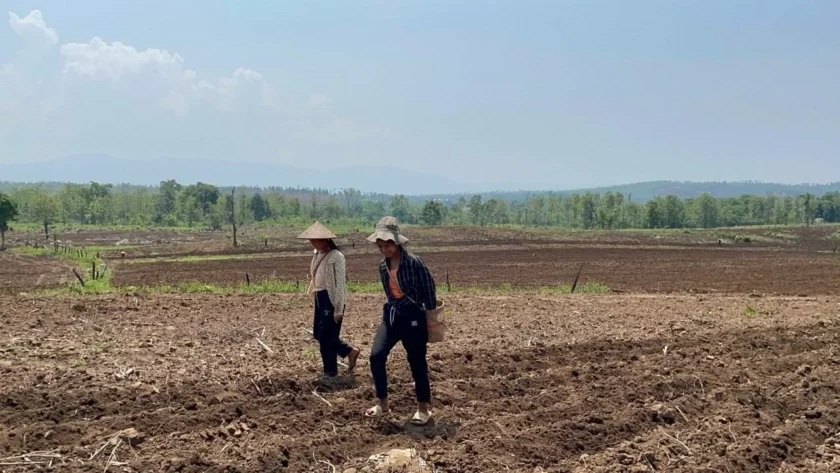
For displaced farmers, it is time to harvest peanuts from their fields. However, they are not only worried about how much of their crops they will be able to harvest, but also about when drones carrying bombs might appear in the sky.
Recently, junta forces have frequently carried out drone attacks against displaced people working in their fields in eastern Hpruso Township, also known as Kaylyar Township.
On September 22, a man working in a peanut field was injured in a drone attack by junta forces. On September 26, a drone dropped a bomb on a village where a funeral was being held, seriously injuring a displaced woman.
This is the time displaced farmers return to their fields to harvest their peanuts. At the same time, some farmers are also planting peanuts for a second time.
Growing peanuts provides displaced people with an additional source of livelihood. However, as they return to their fields to earn a living, displaced farmers worry not only about dangers on the ground but also about the threat of drone attacks from the sky.
Local news sources reported that a total of seven displaced people were injured in August and September as a result of drone attacks carried out by advance outposts of junta forces.
In eastern Hpruso Township, or Kaylyar Township, there are more than 800 households in displacement camps, with a population of over 4,000 people.
On December 24, 2021, more than 40 civilians were burned to death in a mass killing near Moso village in Hpruso Township. Now, frequent drone attacks by junta forces raise fears and anxiety among displaced people who must travel to their fields to work.
“The large drone can travel a distance of around four kilometers and carry two bombs weighing 11 kilograms each, so it is quite effective. We don’t know the exact type yet, but it appears to be a large quadcopter drone with four arms,” a frontline source said.
The military junta has increasingly relied on drones in its military operations across multiple fronts. In previous years, the drones commonly seen in Karenni State were mostly used for basic reconnaissance. However, this year, junta forces have increasingly carried out attacks using bomb-carrying drones, frequently targeting civilians, including peanut farmers.
The drones used by junta forces and revolutionary forces differ in terms of technology, resources, and operational methods. The junta uses advanced military-grade drones, high-tech reconnaissance drones, and drone defense systems officially purchased from foreign countries, including Russia and China. It frequently combines drones with conventional airpower, including fighter jets and helicopters, to launch aerial offensives.
The junta has also changed its drone warfare strategy. Rather than deploying drone units only at permanent battalion bases and strategic military positions, it has begun assigning small drone teams to accompany infantry columns, mobile frontline units, companies, and even small security outposts.
As a result, drones are now used not only to conduct route reconnaissance as troops advance but also to launch immediate bombing attacks when fighting breaks out. Due to the change in drone strategy, not only revolutionary forces and security outposts but also villages where civilians live are increasingly suffering from drone attacks.
A 45-year-old man from a displaced people’s committee said that drone attacks against civilians were being carried out by advance outpost units of junta forces.
“The groups moving ahead to establish security outposts are now attacking us more frequently with drones,” he said.
At present, junta forces control the main Loikaw–Demoso–Hpruso–Bawlakhe road, while their advance outpost units are increasingly carrying out drone attacks against displaced people traveling to their fields.
Traditionally, farmers have kept their eyes on the ground, bending their heads as they dig, till, and weed the soil to make a living. Now, they must also live with the fear that a drone could descend from the sky at any moment.
A displaced male farmer who grows peanuts expressed his anger over the targeted drone attacks against civilians.
“We are simply trying to make a living by working on our own farms. When they come and attack us with drones like this, we feel hurt,” he said.