




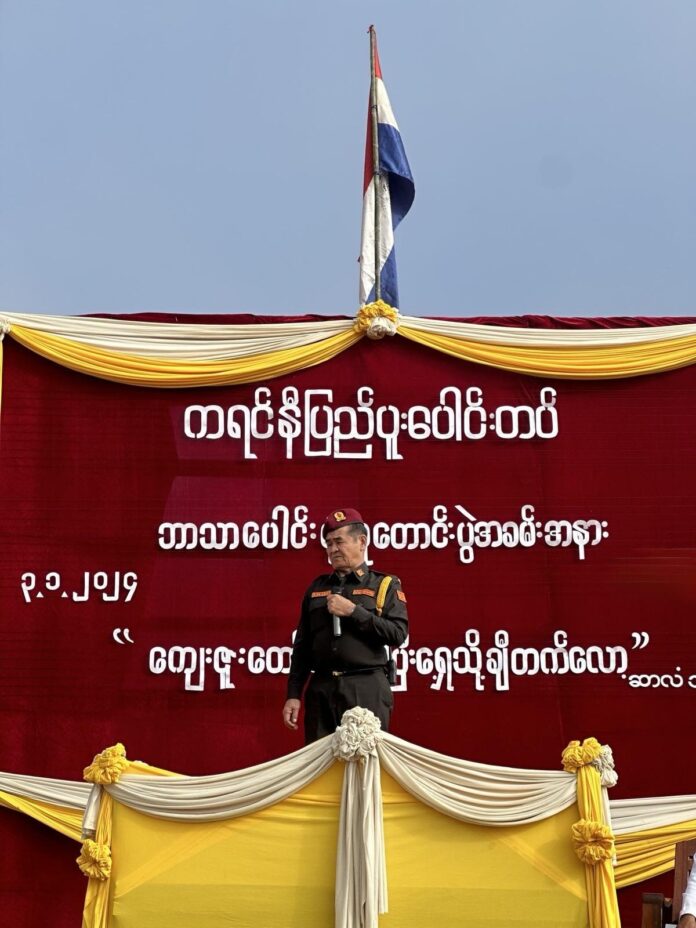
Introduction A compelling imperative exists in Karenni State in 2026 for the unification of all revolutionary elements under a single “United Karenni State Army” (UKSA), a sentiment shared by certain military and political leadership, the general populace, and frontline combatants. The clear desire among the youth, soldiers, and the public for the reintegration of revolutionary forces into a monolithic entity stems from a collective understanding that achieving victory against the incumbent military council (SAC) necessitates operating under the principle of “one blood, one voice, and one order.”
The military engagements over the five-year duration of the “Spring Revolution” unequivocally demonstrate that decisive victory is unattainable when numerous fragmented groups operate with a self-serving mentality. While some inter-group military collaboration has yielded tactical successes over the past five years, a state of definitive victory remains elusive. Conversely, the adversary is presently initiating counter-offensives and consolidating its territorial control. Therefore, to secure broader and more stable territorial jurisdiction and military achievement, the revolutionary forces must be integrated under a singular Chain of Command (COC). This strategic unification is the sole mechanism through which the SAC can be permanently expelled from Karenni State, enabling, if required, a coordinated advance towards Nay Pyi Taw alongside other ethnic revolutionary allies. In essence, unity, a single COC, and a unified military structure are fundamental prerequisites for defeating the enemy.
The Karenni Political Roadmap and the State Army
The formation of the Karenni State Army is inextricably linked to the evolving political framework of Karenni State. It is anticipated that by mid-to-late 2026, the Karenni State Consultative Council (KSCC) will promulgate a transitional constitution, which is expected to be subsequently enacted by the Karenni State Interim Parliament. Following the enactment of the constitution, the Karenni State Interim Executive Council will oversee an electoral process culminating in the selection of a state government by the Karenni populace. Consistent with the new constitutional mandate, the duly elected government will establish a Department of Defense, under whose auspices the State Army will be positioned.
Presently, pending the formal establishment of the Defense Department under the Interim Executive Council, the Karenni Military Coordination Committee – Joint Chief of Staffs (JCS) is tasked with overseeing various command and defense functions. The Karenni State Interim Parliament (KSIP) is nearing the final stages of deliberation and enactment of a comprehensive Military Act designed to manage coalition matters with all relevant forces. This Military Act delineates the systematic process for the formation of the UKSA (Karenni State Army).
Upon its enactment, the Karenni State Military Act will extend its jurisdiction to all revolutionary forces operating within Karenni State, encompassing Ethnic Revolutionary Organizations (EROs), groups established post-2021, Local PDFs, Central Region PDFs operating under the NUG-MOD, and independent entities. Consequently, all revolutionary organizations within Karenni State will fall under the purview of this legislative framework. Consultations regarding this Act are understood to have already taken place with the revolutionary forces in Karenni State.
Structure of the Army
The Karenni Military Act stipulates that the initial formation of the Karenni State Army will comprise the constituent groups currently integrated into the Karenni Military Coordination Committee – Joint Chief of Staff (JCS). The current membership of the JCS includes the KNPP/KA, KNPLF, KNSO, KNPDP, KNDF, and Local PDFs (DMO, MB, LK). Thus, the foundation of the State Army will be established with these organizations.
As per the organizational schema, the Chief Minister (or President) of the Karenni State Government will serve as the Commander-in-Chief, while the Minister of Defense will head the Defense Department. The State Army will be structured and administered under the authority of the Defense Department. This arrangement is consistent with the principle, enshrined in the Karenni Constitution and democratic standards, of maintaining armed forces under the ultimate control of a civilian government elected by the people. The structure further specifies other essential military characteristics and codes of conduct.
The Current Status of Revolutionary Forces in Karenni State
With the exception of the Central Region PDFs under the NUG-MOD and a small number of groups that do not assert a Karenni national identity, the revolutionary forces within Karenni implement military operations under the COC of the Karenni Military Coordination Committee (JCS). They execute military strategy through a unified command structure, and defense expenditures are equitably managed under the JCS framework. Taxes collected by the IEC are allocated to individual groups within the JCS based on a predetermined percentage, with a specific proportion earmarked for JCS collective defense expenditures. Since the inception of the JCS, military operations across Karenni State following 2024 have been conducted under its centralized management.
Nevertheless, not all organizations within the JCS are prepared to fully integrate into the UKSA as the formal Karenni State Army. The proportion of revolutionary organizations expressing full commitment to joining a formed State Army is estimated to be less than 10%. Some EROs indicate they will only join after the establishment of a robust and systematic political infrastructure, while others perceive the revolution as a coalition alliance and intend to retain their distinct organizational identities post-victory. A number of groups are also adopting a precautionary, wait-and-see posture. Apart from the KNDF, certain Local PDFs, and one or two PDFs originating from Southern Shan State, there is a notable reluctance among most other post-2021 groups to commit to full integration.
The Aspiration of the Karenni People
It is an indisputable reality that the Karenni populace strongly desires the merger of all revolutionary forces into a singular army. While no precise empirical study has been conducted, the public’s overwhelming aspiration is for a rapid military victory and the swift successful conclusion of the revolution. The people yearn to return to their homes, having endured five years in mountainous conditions. Internally Displaced Persons (IDP) camps have become targets for aerial bombardment. The public has made immense sacrifices of life, habitation, and property. Every moment spent under temporary shelter constitutes a significant hardship. The unanimous demand of the Karenni people is for the unification of revolutionary forces, the establishment of a single Karenni State Army, and the ultimate success of the revolution.
Prior to the Spring Revolution, a Major from an ERO once remarked: “If a citizen hoes the ground five times, only one hoe’s worth is left for his family.” This was a metaphor signifying that if four armed groups existed in Karenni, all four would impose taxes on the populace. Similarly, during the Spring Revolution, the emergence of numerous new groups in addition to the original EROs has occurred. The public is burdened with supporting these diverse revolutionary organizations. Although collective tax collection instituted by the IEC has mitigated individual group tax impositions, instances still persist where the public is required to provide separate contributions to various organizations. The proliferation of organizations constitutes a significant burden on the people. The public does not require additional revolutionary groups; rather, they advocate for the merger of existing entities. The populace suffers from the inherent fear associated with having to engage with multiple armed entities. It is unequivocally certain that the public desires a systematic, disciplined, and unified military force.
Resources and the Revolution
To secure the financial resources requisite for the revolution, the state’s surface and subsurface natural resources are being extracted and sold. Virtually all revolutionary forces are involved, directly or indirectly, in resource extraction activities. Most organizations are directly engaged in the process. Just as resources were extracted—with varying degrees of legality—under the sanction of successive governments prior to the revolution, natural resources continue to be exploited without adequate restraint during the Spring Revolution under the rubric of revolutionary necessity.
Resource extraction undertaken by previous governments yielded negligible benefits for the state, primarily resulting in environmental degradation. Currently, the percentage of profits from resource extraction that genuinely accrues to the public is minimal. Taxes derived from resources are prioritized for military expenditures and allocated quotas for revolutionary organizations, resulting in a marginal flow of funds back into essential public services such as education and health. Circumstances exist that raise serious doubts as to whether the profits generated from resources extracted in the name of the revolution are consistently channeled toward the interests of the revolution itself.
It is regretfully observed that self-serving actors are exploiting the period of conflict to maximize the extraction and sale of resources. State resources are the collective heritage of all citizens and future generations. Should excessive resource extraction persist under the guise of the revolution, Karenni State risks being reduced to an ecologically depleted and barren landscape post-revolution. Just as the protracted nature of the revolution is directly correlated with resource depletion, the fragmentation and proliferation of revolutionary groups in Karenni State are directly proportional to excessive resource extraction and deeply entrenched organizational disunity. Only through the systematic management of resource profits can both the revolution and the public derive sustainable benefit.
Rationale for the Formation of the Karenni State Army
Experiences since the 2021 coup demonstrate the indispensable need for a systematic, disciplined, and unified Karenni State Army. Notwithstanding its inhumane actions, the military council’s army, as a dictatorship, possesses discipline and a single chain of command—a fact that cannot be ignored.
The revolutionary forces opposing the terrorist army, while morally distinct from the dictatorship, must constitute an army that is no less disciplined than the SAC, characterized by a systematic structure, orderly command hierarchy, and strict adherence to international law and military codes of conduct. The terrorist army has been financially sustained by public funds for seven decades and is actively supported by influential nations such as China and Russia. The adversary commands powerful allies and modern weaponry, and is bolstering its ranks through compulsory conscription legislation. To effectively confront such a formidable and well-equipped enemy, revolutionary forces cannot afford to operate in a fragmented manner.
Unity and discipline are paramount for the revolutionary forces. Should the inherent advantages of the revolution—such as superior knowledge of the terrain, high morale, and adequate manpower—be combined with systematic organization and strategic command, victory against the terrorist army becomes inevitable.
Revolutionaries must guard against becoming warlords while engaged in combat against a military dictatorship. Furthermore, the desire to perpetually maintain the status of a revolutionary army or organization is indicative of warlordism. The military must refrain from intervention in civilian governance sectors. If the military assumes involvement across all civilian domains, it becomes indistinguishable from the SAC army. Even during the revolution, when military affairs are prioritized, the military must remain under civilian administrative oversight.
The current revolution, largely spearheaded by the youth, is fundamentally a systemic change revolution. Consequently, all detrimental legacies of the previous system must be eradicated and replaced. The revolution’s success is not limited to the mere downfall of the MAL (Min Aung Hlaing) army. All doctrines and practices that sustain dictatorship must be dismantled. A new epoch and political system must be constructed that guarantees a just and harmonious society devoid of oppression, injustice, or discrimination.
Therefore, to prevent the ascendancy of warlordism, to preclude the re-entrenchment of dictatorship, and to evolve into a systematic, professional military force, the Karenni State Army must be established and placed under the authority of a civilian government. A contemporary analysis of the ground situation reveals that the resistance is currently confronting intense counter-offensives from the SAC. In crucial townships such as Pekon, Loikaw, Mobye, Demoso, Hpruso, and Bawlakhe, the SAC is employing heavy airstrikes, modern drone technology, and massive troop deployments. The enemy gains a strategic advantage in areas where it can effectively integrate firepower and centralized command. Conversely, in regions characterized by disunity and operational incoherence among ground forces, the enemy achieves the upper hand. Thus, military success is directly proportional to the integration of all forces under a single strategic command. The formation of a Karenni State Army, which unifies all revolutionary forces, is therefore a critical necessity.
An Army Not Predicated on Self-Interest
The successful formation of the Unified Karenni State Army (UKSA) will facilitate the eradication of operations driven by the benefit of specific groups. Activities motivated by political gain, media promotion, or organizational commercial profit can be entirely eliminated. The need for a “debt of gratitude” relationship with the public will cease to exist. Currently, situations arise where the public is compelled to treat armed groups as benefactors. With the formation of a State Army, the forces will function solely as public servants under the government’s Defense Department, accountable to the people.
As an army not predicated on self-interest, involvement in commercial endeavors will significantly diminish. Armed groups will be prohibited from engaging in business activities. Mining, logging, the operation of restaurants, or running entertainment venues are activities incompatible with military duties. Personnel desiring to pursue commercial activities must formally resign from military service and operate as civilians.
A military force precluded from engaging in business must receive comprehensive support from the government. The government must assume responsibility for soldiers’ remuneration, provision of armaments, food and logistical supplies, care for disabled combatants, support for the families of the deceased, and comprehensive life assurance programs for those transitioning from military service to civilian life.
A Dignified State Army (Government Army)
All revolutionary forces engaged in combating the military dictatorship rightfully take pride in their status as revolutionaries, a pride fully warranted by the magnitude of their sacrifices.
However, in the international context, while acknowledged for their commitment to democracy, federalism, human rights, and justice, they are frequently characterized as “resistance forces,” “freedom fighters,” or “rebel forces” in opposition to a central authority. Essentially, they are recognized as insurgents fighting against a military government. While the NUG is accorded recognition as a government, the formal recognition of PDFs as a governmental army remains a distinct issue.
The revolution has now persisted for five years. Analogous to the necessity of forming a governing body to rival the military regime during the revolution, the formation of a government army is equally essential. While the current configuration may be acceptable for a short duration, as the revolution becomes protracted, it is imperative for the forces to transition into a systematic State Army. Only then will domestic and international actors recognize it as a dignified government army accountable to the people. Should groups remain solely as Ethnic Revolutionary Organizations (EROs) or local defense forces, they face the risk of stagnating as mere rebels or warlords, failing to evolve beyond the level of people’s militias.
As the revolution lengthens, a time will inevitably arrive when groups merely boast about their duration—30 or 40 years of conflict—rather than substantive achievements. The legacy to be bequeathed to succeeding generations is not a proliferation of armed groups, the longevity of the revolution, or unit anniversaries. The authentic legacy of a genuine revolution must be a fundamental change of era and system. The enduring legacy must be a system capable of establishing a federal democratic, free, peaceful, and just society.
To attain the status of a dignified state government army that adheres to international law and commands the respect of the global community, the Karenni State Army must be established.
Consequences of Failure to Form the UKSA
The ramifications of a failure to unify the forces in Karenni warrant analysis from multiple perspectives.
Impact on the Military Situation In the current military environment of Karenni State, operations are being executed under the command structure of the JCS. While demonstrable successes have been achieved, considerable command and control challenges persist. These difficulties range from the complexities of separating budget appropriations due to the necessary division of defense funds among constituent groups, to the challenge of coordinating numerous entities for the implementation of military strategy. Despite substantial troop numbers, the absence of a unified command represents a major impediment to decisive victory. The degree of military success and territorial control achievable through a “coalition” framework is inherently limited, and opportunities for greater achievement are being foregone. In plain terms, the current status quo is unsustainable under the existing coalition arrangement. The terrorist SAC army has reconstituted and is now penetrating back into Karenni from Southern Shan State, reaching areas situated between Bawlakhe and Hpasawng. Territories previously secured during the “1111 Operation” in 2023, including Pekon, Mobye, Loikaw, and Demoso, are witnessing the re-entry of the SAC, not only into the towns but deep into forested and mountainous regions. Should a systematic troop formation and strategic warfare implementation remain elusive, the military situation will inevitably deteriorate. If a unified army cannot be established and the enemy cannot be combatted with cohesion, the adversary will gain the advantage, leading to a regression of the military situation. A failure in the military sector would preclude the continuity of administrative, social, and economic sectors; military success is the cornerstone upon which all other sectors are built.
Territorial Disputes and Conflicts of Interest There are at least five classifications of revolutionary groups in Karenni:
- Ethnic Revolutionary Organizations (EROs)
- State-based People’s Defense Forces (e.g., KNDF, Local PDFs)
- National Unity Government (NUG) Ministry of Defense PDFs
- Minor groups unaffiliated with either the Ministry of Defense PDFs or Local PDFs
- Organizations not actively engaged in resistance against the military council
The primary analytical focus is on types (1), (2), and (3).
Type 1: EROs possess long-established histories (20-70 years), distinct political platforms, and defined territories predating 2021. Their interests encompass administration, taxation, and resource extraction within their respective areas of control. Candidly, beyond economic interests, these issues often impinge upon sensitive ethnic matters. Absent the formation of a single army, territorial disputes and conflicts over resources are an inevitable outcome. Confrontations regarding resource exploitation and territorial incursions will materialize. Conflicts may erupt between revolutionary groups or between groups and the civilian populace. Post-2021 groups (MOD PDFs, Local PDFs, KNDF) also exist. While major territorial disputes may not be pronounced yet, they maintain alliances with proximate EROs and are increasingly involved in resource extraction and tax revenue sharing. Both organizational and individual involvement in resource extraction has commenced. Consequently, interest-based clashes among these groups are a plausible scenario. The absence of a unified force will compel groups to compete for their individual survival and funding, escalating conflicts of interest. This would have profoundly negative consequences for the revolution. Such conflicts also impose a burden on the public, who face multiple taxes in “mixed control areas” and may protest resource extraction, leading to confrontations that benefit neither the revolution nor the people.
Impact on the Rule of Law With the proliferation of armed groups, social issues involving military personnel are frequently reported. Problems arise between soldiers and the public, or among soldiers themselves. The jurisdiction for resolving these matters—civil or military court—is often ambiguous; resolution is frequently sought through internal mechanisms. The practice of resolving issues between the civil and military sectors in civilian courts is virtually nonexistent, thereby severely restricting justice for civilians. Civil laws often appear to be non-binding on armed groups. Certain members engage in illicit activities such as drug trafficking or theft, and despite the awareness of the public and the Karenni State Police (KSP), reporting or apprehension is frequently deterred by fear. Instances have been documented where armed groups employed force to retrieve detained members from police stations or issued threats against law enforcement personnel. This demonstrates that the rule of law implemented by the KSP is not consistently applied to all armed groups.
The KSCC has a defense policy, and a military act has been drafted. The successful implementation of the rule of law is contingent upon all groups equally respecting and adhering to this act. The challenges to the rule of law can only be comprehensively addressed if all forces are placed under the supervision of a civilian government.
Conclusion A multitude of other considerations pertain to the formation of the State Army, particularly the paramount importance of achieving political consensus among all revolutionary forces. However, by synthesizing the historical context of the state, the revolutionary trajectory of the EROs, and the momentum of the contemporary Spring Revolution, it is essential to negotiate and devise a solution regarding the administration of the defense sector—a function central to state building—and to determine the most appropriate framework for the establishment of the Karenni State Army.