





Kantarawaddy Times
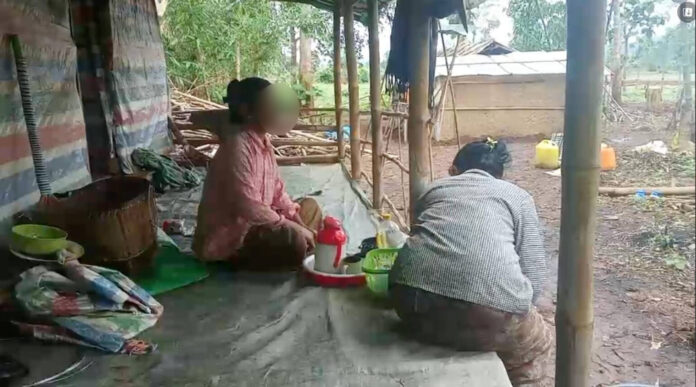
On a drizzly afternoon, two middle-aged women are chatting on the veranda of a makeshift hut in a displacement camp. These two women, named Daw Htyo Myar and Daw Myar Moe, fled from Pinlaung Township in Southern Shan State to seek refuge in Karenni State.
Although they came from different villages in Pinlaung Township, they met only after becoming internally displaced people and settling in the same camp. They have now been living in the “Htay Kay Lyar” displacement camp on the western side of Demoso for about seven months.
Daw Htyo Myar, now 45 years old, appears to be still very strong because she used to work in agriculture. However, due to the ongoing conflict and displacement, she can no longer farm or tend to her land. Having always been an active and hard-working person, her daily life now feels empty and restless.
“When I visit neighbors to chat, it helps relax my mind. But when I’m alone, thoughts overwhelm me. It’s mentally exhausting,” she says of her now-idle days.
To pass time and relax her mind while staying alone, she often prays or listens to songs.
Back in her home village of North Saung Lan, in Pinlaung Township, she always had work throughout the year. She grew both rainy and dry season rice, along with crops like corn and garlic for income.
Until September 2024, before being displaced, her farmland was ready for harvest with golden paddy fields and corn waiting. But when the war reached their village, they had to flee, leaving everything behind.
During their fleeing, their entire village with over 80 houses was burned down.
“I still don’t know why our village, North Saung Lan, was targeted like that to burn down,” Daw Htyo Myar emphasizes.
Their paddy and corn fields were also destroyed in the fires. At the time of fleeing, she thought they’d return within ten days or at most a month. In this emergency escape, she only managed to bring two sets of clothes, some basic food, and a small set of kitchen items.
Now, Daw Htyo Myar says she has lost everything, including her home, utensils, and farming equipment. Even if the war ends and they can return, she cannot imagine how her family would restart their lives.
“Even if we could go back, where would we live? We have nothing left, not even a house. If we continue to stay here, we don’t know what to do, especially when working. It’s extremely stressful,” she says.

This is the situation faced by many Shan IDPs who have been displaced to Karenni State. Daw Myar Moe, who is also 53 years old, and her family face the same hardships.
Daw Myar Moe is originally from South Saung Lan village in Aungpan Township. While her house may still be standing, she heard through others that heavy weapons damaged it badly, and all belongings and farming tools inside were destroyed.
“If you count everything, we’ve probably lost forty to fifty million kyats, and that doesn’t even include the house,” she says.
Currently, there are no jobs available for income in the displacement camp, so both Daw Htyo Myar and Daw Myar Moe worry daily about food and survival.
“When the donated rice runs out, where will we get food from?” Daw Htyo Myar asks with no real answer in sight.
“When I think about whether we or our children might die from hunger tomorrow, it breaks my heart,” Daw Myar Moe stressed.
Both women used to be self-sufficient through farming and never had to worry about food. But now, their displaced life has forced them to cut a meal per day.
“As for vegetables, don’t even ask. We forage for edible leaves with anything we can find around here,” says Daw Htyo Myar.
They were chatting about if there had not been any war, they would have been extremely busy with farming this time of year.
“No matter how hard things are, we will get our former lives back only after the revolution ends quickly. So even though we have nothing left, we must face these hardships,” Daw Myar Moe says.
“Wherever you go in the forests and mountains, it’s only people like us, IDPs. So we’re not the only ones suffering. Everyone is struggling. But if we look at it from a long-term, national perspective, for peace and development, we gain strength,” she adds.